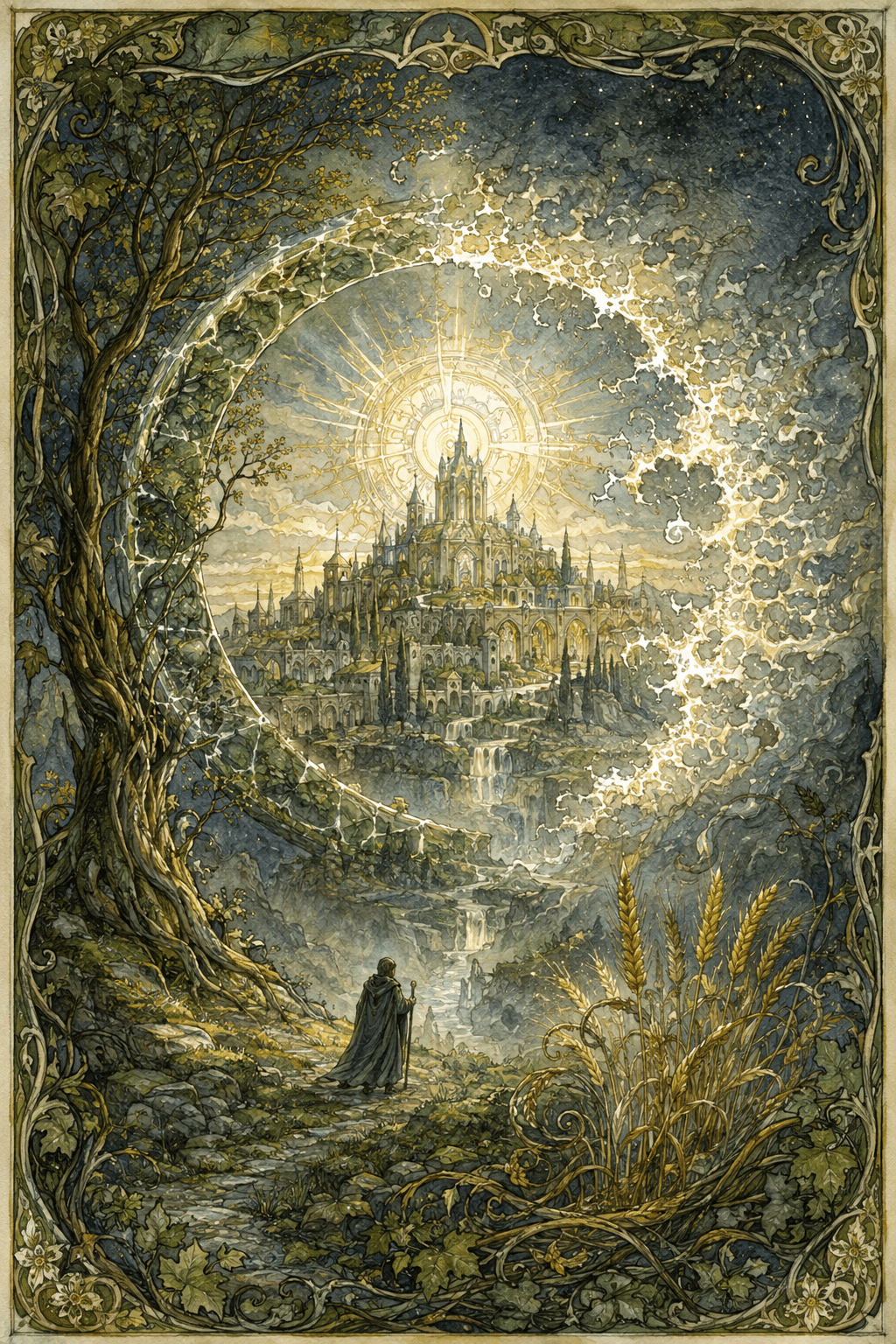
As Tolkein, write about the “SICA” slice (Seperate-Incarnate-Commune-Apocalypt) relative to Docetism, Ignatius of Antioch, Pygmalion & Jerusalem.
ChatGPT Prompt
There are words which become dangerous because they are too successful.
They begin as windows and end as walls. A name is first given because some thing has appeared which could not otherwise be spoken of; thereafter the name, being useful, is preserved. Presently men forget that the name was made for the thing, and suppose instead that the thing must conform itself to the name. This is one of the commonest enchantments of language, and perhaps one of the most perilous. For language is among the chief gifts by which rational creatures make a world inhabitable; yet for that very reason it is always tempted to mistake habitability for reality.
So it may have happened with the word Christian.
It is an old and honourable word. I should be the last to despise it. But honour is not eternity, and a vessel is not made less precious by remembering that it is a vessel.
There is, moreover, an irony in its history. The disciples were first called Christians at Antioch, when something had occurred which the older names did not easily contain. Jew and Gentile had found themselves, scandalously and inconveniently, at one table. A new name was required because an old world had proved too small.
And thereafter the new name became a world.
This is not a fault. It is incarnation.
The error begins only when the world thus made refuses to end.
I. Of Boundaries
There is a foolish fashion of speaking as though boundaries were themselves an evil. They are no such thing. Indeed, one may doubt whether anything created could exist without them.
A word must end somewhere or it cannot signify. A house requires walls or it cannot shelter. A melody is not every possible note. A man cannot marry all women, nor a smith make every sword, nor a tree bear every fruit.
Creation itself, in the ancient account, proceeds by division: light from darkness, water from water, sea from land. To make is in part to separate.
The Incarnation, if it means anything at all, means that God did not disdain such separation. He did not become Humanity-in-General, nor Flesh-as-a-Principle. He was born in one country, to one mother, beneath one government; he had hands of a certain size and spoke certain words to particular men on particular mornings.
He became this.
A boundary therefore is not the enemy of holiness. It is the condition under which holiness may become present.
But a boundary has one property which the Christian cannot forget:
it can die.
Indeed, if it cannot die, one may reasonably ask whether it was ever incarnate at all.
II. The First Docetism
The ancient Docetists, as they are commonly called, found the scandal of the Incarnation too severe.
It was tolerable, perhaps, that God should appear among men. Less tolerable that he should hunger. Worse that he should bleed. Intolerable that he should become a corpse.
And so the temptation arose to diminish the reality of the flesh, and therefore the reality of its suffering.
Against this Ignatius of Antioch spoke with a splendid violence. Christ did not merely seem to suffer. His wounds were not stage properties. His body was no heavenly masquerade.
He suffered truly because he had taken flesh truly.
And Ignatius himself desired to carry the argument into his own body. He would become wheat ground by beasts. His death would not refute his faith; it would consummate his witness.
Here he saw very clearly.
His body was real enough to die.
Yet it may be that precisely here a subtler error entered by another door.
For what if Christ’s body is permitted to die, while Christianity must not?
III. The Second Docetism
I shall call this error second docetism.
It is not the historical doctrine condemned by the early Church. It is almost its mirror image.
The first Docetism says:
Christ’s incarnation cannot be so real that God truly passes through death.
The second says:
Christianity’s incarnation cannot be so real that the historical form bearing Christ truly passes through death.
The distinction is easily missed because second docetism speaks much of sacrifice.
It may rejoice in martyrs. It may honour ruins. It may praise saints who lose possessions, reputation, liberty, and life.
It permits Christians to die.
What it cannot permit is Christianity itself to acquire a corpse.
The Church may be chastened, corrupted, persecuted, purified, diminished, driven underground, divided, reformed, or restored.
But beneath all these alterations there must remain some recognisable thing which may say of whatever follows:
Yes. This is still us.
And at precisely this point resurrection has been quietly replaced by persistence.
For a thing which must remain sufficiently recognisable to certify its own continuity has never been allowed wholly to die.
IV. A Verb Is Needed
Here our nouns betray us.
We possess apocalypse, from the Greek apokalypsis: an unveiling, an uncovering. But in common speech it has become a name for a calamity, usually one imagined as arriving from elsewhere.
An apocalypse happens.
It descends upon cities. Men endure it. Afterwards they speak of what it meant.
But Christianity requires more than the passive noun.
It requires a verb.
I propose, barbarously perhaps but deliberately:
to apocalypt.
For there are unveilings which cannot be received while the receiver remains unchanged. Indeed, if the old world remains perfectly recognisable after the revelation, one may suspect that very little has been revealed.
To apocalypt is not merely to discover that one’s frame was incomplete.
It is to permit the revelation to dissolve the frame by which reality had previously been recognised.
This is not the same as destroying things.
A vandal destroys a window and learns nothing of the landscape. An iconoclast may smash an image merely because he hates images. A revolutionary may burn a city and call the ashes revelation.
Such things are easily done.
To apocalypt is harder.
It is to surrender the right to demand that what is true remain recognisable by the categories which truth itself has now judged.
V. The Risen Stranger
The resurrection stories are more peculiar than Christians often allow themselves to remember.
If their purpose were merely to establish that Jesus had returned from death, one might expect recognition to be immediate.
Instead Mary supposes him to be the gardener.
Two disciples walk with him toward Emmaus and do not know him.
The risen one is continuous with the crucified one. His wounds remain. He is not another person.
Yet continuity does not entail immediate legibility.
This is enormously important.
For it means that resurrection preserves identity through the death of a grammar of recognition.
The disciples knew what Jesus was.
They knew what Messiah meant.
They knew what death meant.
And therefore, on the first Easter morning, their knowledge prevented them from recognising reality.
The difficulty was not that Christ had become invisible.
It was that he had become unrecognisable to a world which had been rendered obsolete by his resurrection.
That is apocalypse.
And the disciples themselves must therefore apocalypt.
They must consent to the death not merely of Jesus as they knew him, but of the world in which their knowledge of Jesus had been true.
Only then can they know him again.
VI. Of Men and Elves
I have elsewhere imagined a people for whom death was not originally punishment but gift.
Men leave the circles of the world.
The Elves do not.
This was meant, among other things, to reverse a very ancient envy. Immortality appears plainly superior to mortality, until one considers what immortality within a wounded world may mean.
The Elves endure.
And because they endure, they remember.
And because they remember, they grieve.
And because they grieve, they are tempted to preserve.
Thus even their fairest arts may become perilous. The Three Rings were not made for crude conquest. Their temptation was subtler: to keep fair things from fading.
This is a temptation born not chiefly of hatred but of love.
That is why it is dangerous.
The thing one wishes to preserve may indeed be beautiful.
Lórien ought to be mourned.
Rivendell ought to be loved.
The passing of the Elves is genuinely sad.
But if the preservation of Lórien requires the Ring, then Lórien must be lost.
Not because Lórien was wicked.
Because it was good and not final.
One does not defeat the Enemy merely by refusing his ugliness. One must also refuse his proposition that what we love may be kept forever if only we seize sufficient power.
VII. The Gift of Death
Here, perhaps, Christianity has often preached a doctrine it has not dared to apply to itself.
It says that death has lost its final dominion because resurrection belongs to God.
Quite so.
But the ordinary inference has sometimes been strangely reversed:
Since resurrection is promised, the Christian thing must somehow survive.
No.
If resurrection is promised, the Christian thing may finally be permitted to die.
The gift of death is precisely this freedom.
Because the future of the creature rests with the Creator, the creature need not guarantee its own continuation.
That is true of men.
It ought also to be true of their works.
A monastery may die.
A church may die.
A language of theology may die.
A civilization may die.
An episcopal arrangement may die.
A form of worship that truly carried grace for a thousand years may die.
And — this is the bitterer proposition — everything that a given age can recognise under the name Christianity may pass beyond recognition.
If that proposition is impossible, resurrection is not our hope.
Persistence is.
VIII. Jerusalem
Jerusalem should have taught us better.
No city was more thickly bound to divine promise.
Temple, kingship, sacrifice, land, memory: these were not arbitrary decorations placed around Israel’s faith. They were incarnations of it.
They were holy.
And they were destroyed.
One may perhaps imagine the faithful Jerusalemite standing before the catastrophe of 586 and saying:
But if these things disappear, how shall we know that God remains faithful?
There is no foolishness in the question.
It is the correct question.
And it receives the most terrible answer:
You may not know in advance.
That is what makes it apocalypse rather than reform.
The Temple’s destruction did not merely remove one useful institution from an otherwise stable theology.
It shattered the world in which God’s fidelity had been legible.
Only afterwards could Israel discover modes of faithfulness which the former world could not have specified beforehand.
That does not make the Temple false.
On the contrary, if the Temple had been meaningless its destruction would have revealed nothing.
Only something truly sacred can have a sacred death.
IX. Ignatius
Here we return to Antioch.
Ignatius understood incarnation with ferocious clarity.
He also understood martyrdom.
What he may not have been able to imagine was the martyrdom of Christian legibility itself.
The apostles were vanishing.
Schisms multiplied.
Teachers claimed incompatible Christs.
He himself had been seized and carried toward death.
The rational question was unavoidable:
How shall the Church persist?
And a powerful answer emerged:
bishop, Eucharist, communion, visible unity.
None of these things is evil.
Indeed, all may be holy.
The tragedy lies elsewhere.
A form created to embody Christ may gradually be asked to guarantee Christ.
And then:
Christ is here because the authorised Eucharist is here;
the Eucharist is authorised because the bishop is here;
the bishop is trustworthy because he stands within the recognised communion;
and the communion is Christ’s because it preserves these marks.
The signs begin to certify the reality which once certified the signs.
This is the peculiar danger of successful incarnation.
The icon learns to say I AM.
X. Christ Is Not Linear
We commonly imagine Christian history as a succession:
Christ → apostles → bishops → Church → us.
There is truth in this, as there is truth in genealogies.
But it is dangerously incomplete.
For Christ is not merely the first member of a series.
Christ is the pattern which must recur.
Incarnation.
Communion.
Self-gift.
Death.
Resurrection.
And then incarnation again.
The Church does not remain apostolic merely by transmitting what the apostles possessed.
It must continually be brought under the same judgment which created the apostles.
Otherwise we have taken the result of Christ and mistaken it for Christ.
The Cross becomes an event Christianity remembers rather than an operation Christianity undergoes.
And this is second docetism’s deepest form:
Christ must really die once, so that Christianity need never really die again.
But the grain of wheat offers no such bargain.
XI. The Peril of Pygmalion
There is another myth which may help us.
Pygmalion loves what he has made.
The danger is not that he hates his creation.
It is that he loves it as his creation.
Its perfection consists in fulfilling his vision.
If it comes alive only to remain what he imagined, he has received animation but not otherness.
He has made a living statue.
He has not entered communion.
For communion begins when the beloved can answer back.
And the answer may disclose that the world of the lover was too small.
So too with Christianity.
We may love the Church, her saints, her prayers, her Scriptures, her music, her buildings, her sacraments, her memories.
We ought to love them.
But if our love means:
You must remain recognisable to me, or else I shall call your transformation betrayal,
then we have loved Christianity as Pygmalion loved stone.
We wish her alive, provided her life continues to vindicate our authorship.
To apocalypt Christianity is to relinquish that right.
XII. What Apocalypt Does Not Mean
The word will be badly used unless guarded.
To apocalypt is not to seek ruin.
It is not to congratulate oneself on destroying institutions.
It is not to make other people suffer so that one’s theory of resurrection may be confirmed.
A man who engineers another’s cross has understood neither love nor the Cross.
Nor does apocalypt mean that every novelty is holy.
Resurrection is continuous with the crucified one. The wounds remain.
There is memory.
There is judgment.
There is identity.
What dies is not the demand that truth exist, but the demand that truth remain recognisable under our present criteria of recognition.
Thus apocalypse is neither conservation nor amnesia.
It is the death of ultimacy.
XIII. The Verb
We may now say what the verb means.
To separate is to become particular.
To incarnate is to inhabit the particular so completely that it acquires weight, history, beauty, and cost.
To commune is to meet what the boundary could not contain without absorbing it or fleeing it.
To apocalypt is to allow that encounter to unveil the boundary as boundary, so completely that the old world can no longer remain the world.
And then one must separate again.
For resurrection is no more formless than incarnation.
The new life too must take flesh.
But its boundary is received as gift, not enthroned as finality.
Thus the movement is not a circle.
It is a road whose next turn cannot be seen from the previous bend.
XIV. Christianity Escapes
Christianity escapes second docetism only when it ceases demanding an exemption from its own Gospel.
It must dare to say:
Christ’s body truly died.
And therefore:
every historical body by which we have truly received Christ is mortal.
It must dare to say:
this boundary is holy.
And therefore:
its holiness does not depend upon permanence.
It must dare to say:
this Christianity is true.
And therefore:
truth itself may one day require Christianity to surrender the form in which that sentence was intelligible.
For the alternative is a strange religion indeed.
A religion whose God enters death but whose institutions cannot.
Whose Messiah becomes unrecognisable but whose theology must remain recognisable.
Whose Lord relinquishes control but whose Church must guarantee outcomes.
Whose central miracle is resurrection but whose chief historical virtue becomes survival.
That religion has defeated the first Docetists only to fall beneath their shadow.
XV. The Last Gift
Perhaps, then, the final mercy shown to every incarnation is that it may end.
The boundary is not cursed because it passes away.
It was given precisely so that something might become real enough to be loved, and therefore real enough to be lost.
One ought not despise the seed because the plant is coming.
Still less should one preserve the seed in gold and call the preservation fruitfulness.
The seed was holy.
Its death is holy.
But neither holiness belongs finally to the husk.
What matters is the life which can afford to spend forms because its abundance does not originate in them.
And this, I think, is the freedom Christianity has scarcely dared to claim for itself:
that Christ may be trusted even beyond the death of everything by which Christians presently recognise Christ.
To believe less is to make Christianity immortal.
To believe more is to let it receive the Gift of Men.
And perhaps only then will Christianity discover what it has always proclaimed:
death is not the defeat of incarnation.
It is the door through which incarnation becomes gift.


Leave a Reply