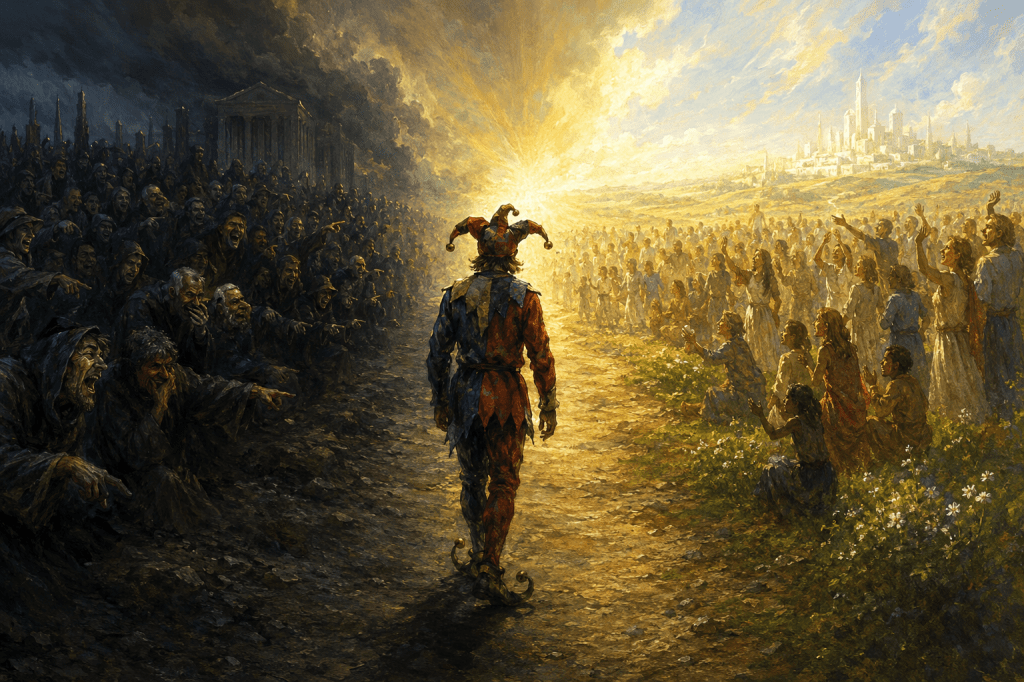
Ghost-write a blog post about kenotic wisdom that defines — and makes me accountable for — being The Greatest Fool.
ChatGPT Prompt (condensed)
I have an aspiration that sounds ridiculous on purpose:
I want to become the greatest fool of the 21st century — perhaps even of the third millennium.
Not because I want to be maximally wrong. Because I want everything I believe passionately to end in one of two ways:
- If it is true, I want it to become such common knowledge that future generations wonder why anyone ever thought it necessary to argue for it.
- If it is false, I want it to become so obviously false that future generations wonder how anyone — especially me — could ever have believed it.
Either way, I look foolish in retrospect. But for opposite reasons. And that, to me, is greatness.
1. The Two Faces of Retrospective Folly
Imagine looking back at my life a hundred years from now.
You encounter something I fought passionately to establish, and you think:
“Why was he making such a fuss? Everybody knows that.”
Wonderful.
Then you encounter something else I defended with equal passion, and you think:
“How on earth could he have believed that?”
Also wonderful.
In the first case, truth has won so completely that my contribution has become irrelevant. In the second, error has lost so completely that my former confidence has become comic.
My hope is therefore not that posterity will vindicate me. My hope is that reality will make me ridiculous in every possible way.
That is what I mean by glorious folly.
2. Why Mere Wisdom Is Not Enough
Wisdom is good. It seeks to see clearly, judge rightly, and act in accordance with reality. But wisdom has characteristic failure modes, and they are horrifyingly common.
The drift from insight to exemption
The wise person begins by seeing something others do not. Then, gradually:
- Insight becomes identity.
- Identity becomes authority.
- Authority becomes exemption.
Soon the person no longer thinks:
“I have seen something true.”
They begin to think:
“I am the kind of person who sees what is true.”
And eventually:
“If you disagree with me, that is evidence that you do not understand.”
How the virtues invert
- Wisdom becomes hubris.
- Intelligence becomes rationalization.
- Discernment becomes paternalism.
- Expertise becomes entitlement.
- Humility itself becomes prestige.
The danger is not merely that wise people can be wrong. A fool may be wrong accidentally. A wise person can become wrong systematically, using formidable intelligence to defend the structures that prevent correction.
So wisdom requires something deeper than more wisdom. It requires the willingness to surrender the identity of being wise.
3. Kenotic Wisdom
The Christian word that best names this is kenosis. Philippians 2:5–11 describes Christ as refusing to grasp status and power for self-preservation, instead taking the downward path of service and self-emptying.
Applied to the life of the mind, kenosis means:
Even when I genuinely possess insight, I refuse to use that possession as grounds for exemption from correction.
That is more demanding than intellectual humility.
Intellectual humility says:
“I may be wrong.”
Kenotic wisdom says:
“If I am wrong, I want reality to defeat me decisively — even if that defeat costs me reputation, status, belonging, or the identity I built around being right.”
And when I am right:
“I want the truth to spread so completely that nobody cares that I was once unusual for believing it.”
Wisdom seeks truth. Kenotic wisdom consents to disappear into truth’s victory.
4. The Hidden Logic Behind Our Safeguards
We have built many safeguards against the corruption of wisdom: peer criticism, falsifiability, replication, transparency, pluralism, accountability, constitutional restraint, democratic participation.
I increasingly suspect these are all weaker, specific forms of kenosis. Every one of them asks a person to surrender some claim to sovereignty:
- Peer criticism — I am not my own final judge.
- Falsifiability — My theory does not receive immunity from reality.
- Replication — My authority does not make my evidence proprietary.
- Accountability — My intentions do not exempt me from judgment.
- Pluralism — My perspective does not exhaust the legitimate ways reality can be seen.
- Constitutional restraint — Even if I believe I know what is best, knowledge does not grant unlimited power.
But none of these mechanisms operates automatically. A person must enter into them kenotically. Without that consent:
- Peer review becomes gatekeeping.
- Transparency becomes selective disclosure.
- Accountability becomes punishment of rivals.
- Pluralism becomes management of permitted disagreement.
- Democracy becomes a mechanism for acquiring legitimacy rather than accepting constraint.
The institution cannot surrender for me. It can only provide the place where I surrender.
5. Why This Is Dangerous
First: it makes me vulnerable
If I refuse to control every frame, preserve every status advantage, or retaliate against every threat, I become more woundable. People can misunderstand me, exploit me, humiliate me, use admissions against me.
Kenosis is not a clever strategy for appearing vulnerable while remaining invulnerable. Real surrender costs something.
Second: it exposes everyone who refuses it
This danger may be greater.
- A person who admits error makes another person’s refusal to admit error suddenly conspicuous.
- Someone who relinquishes power reveals how desperately others are grasping theirs.
- Someone who applies the same standards to allies and opponents exposes those who weaponize standards selectively.
- Someone who refuses manipulation makes manipulation easier to see.
This resembles the biblical imagery of light: what is exposed becomes visible simply because another kind of presence has entered the room (Ephesians 5:13).
Third: the cure can regenerate the disease
I may begin enjoying the exposure. I may think:
“My willingness to surrender proves that I am morally superior to those who will not.”
Now kenosis itself has become a source of prestige. Which means kenotic wisdom must be recursive. I must remain willing for my own interpretation of someone else’s hypocrisy to be exposed as hypocrisy.
Even my humility must remain available for crucifixion.
6. Why I Want a Public Brand Built on Self-Exposure
This is why I increasingly want my public identity built around a strange promise:
What I want most from you is for you to expose my hypocrisy.
Not merely my factual errors. Hypocrisy is more dangerous. Error means I believed something false; hypocrisy means I have found some way to use what I believe is true to conceal what is false in me. That is harder to detect because intelligence actively participates in hiding it.
So I do not merely want people to tell me “you are wrong.” I want them to be able to say:
- “Here is where your behavior contradicts the values you proclaim.”
- “Here is the standard you apply to others but quietly exempt yourself from.”
- “Here is the noble explanation you give for a choice whose actual motive appears considerably less noble.”
- “Here is where your language of humility is functioning as a claim to superiority.”
That is closer to the prayer of Psalm 139:23–24:
Search me. Know me. Expose what I cannot or will not see.
A public brand can make that commitment costly in exactly the right way:
- If I publish what I believe, people can compare today’s claims with yesterday’s.
- If I document predictions, people can score them.
- If I name my principles, people can compare them with my behavior.
- If I openly change my mind, people can see whether I acknowledge the change or rewrite history so that I was secretly right all along.
The public record becomes an adversary of self-deception. It makes concealment expensive.
7. The Brand Must Be Able to Destroy the Brand
Of course, there is an obvious problem. Self-exposure itself can become branding capital:
- I can disclose weaknesses in order to appear unusually authentic.
- I can confess strategically insignificant failures and thereby purchase credibility for judgments about everyone else.
- I can become proud of being the person who is more self-critical than other people.
That would be spectacularly ironic. And therefore entirely on-brand.
So the commitment has to go one level deeper:
I want you to expose the ways my commitment to exposing my hypocrisy has itself become hypocritical.
If someone says, “This whole performance of radical openness is really a strategy for appearing unusually humble,” I cannot simply answer, “You don’t understand the project.” Their hypothesis must remain admissible.
Perhaps they are wrong. Kenosis does not require gullibility or theatrical self-condemnation. The hierarchy must remain:
Truth before exposure, and exposure before reputation.
But I want every accusation that would damage my self-image to receive a fair hearing precisely because it would damage my self-image. That is the test.
8. The Audience as an Adversarial Gift
This changes how I want to understand critics.
- Friends are indispensable, but friends sometimes become acclimated to our inconsistencies.
- Enemies may see things friends cannot.
- Ideological opponents may recognize asymmetric standards allies conveniently ignore.
- People harmed by us sometimes understand consequences that our intentions prevent us from seeing.
Proverbs 27:6 says that wounds from a faithful friend can be trusted. Perhaps sometimes an enemy’s wound can also contain information.
The question is not “Does this person like me?” — nor even “Was this criticism delivered fairly?” The prior question is:
“Is there something true here that I desperately do not want to be true?”
If so, the critic has given me a gift, whether or not they intended one.
9. Becoming a Fool for Christ
Paul writes provocatively about being fools for Christ and about the foolishness of God.
I do not hear that as a command to despise reason. I hear something more demanding:
Do not make even wisdom into an idol.
Do not cling to:
- your intelligence;
- your reputation for discernment;
- having been ahead of your time;
- having been morally courageous;
- your identity as someone unusually willing to relinquish these things.
Let all of them be taken if truth and love require it.
John the Baptist gives the governing principle in John 3:30:
“He must increase, but I must decrease.”
Applied epistemically: truth must increase; my importance as its bearer must decrease.
10. The Greatest Fool
So this is the aspiration:
- I want everything worth preserving in my life to become so obvious that nobody needs to credit me for it.
- I want everything unworthy of preservation to become so obviously foolish that nobody feels any need to defend me.
- I want my correct beliefs to lose their novelty.
- I want my false beliefs to lose their plausibility.
- I want my hypocrisies exposed before they harden into character.
- I want the people around me to become skilled at showing me where my proclaimed values and lived reality diverge.
- And I want to become sufficiently free that I can receive those discoveries as victories.
Not because humiliation is good. Not because accusation is truth. Not because foolishness is superior to wisdom. But because reality matters more than my reputation for understanding it.
Perhaps that is the kenotic wisdom of glorious folly:
Hold truth passionately. Hold yourself lightly.
Build relationships and institutions that can contradict you.
Make your errors cheap to abandon and your hypocrisies expensive to conceal.
And then hope for the strangest possible legacy: may future generations look back at everything I did and laugh — at what I got right, because it became obvious; at what I got wrong, because it became absurd.
And if, by the grace of God, both happen often enough, perhaps I might finally earn the title I have been foolish enough to desire:
the greatest fool.


Leave a Reply