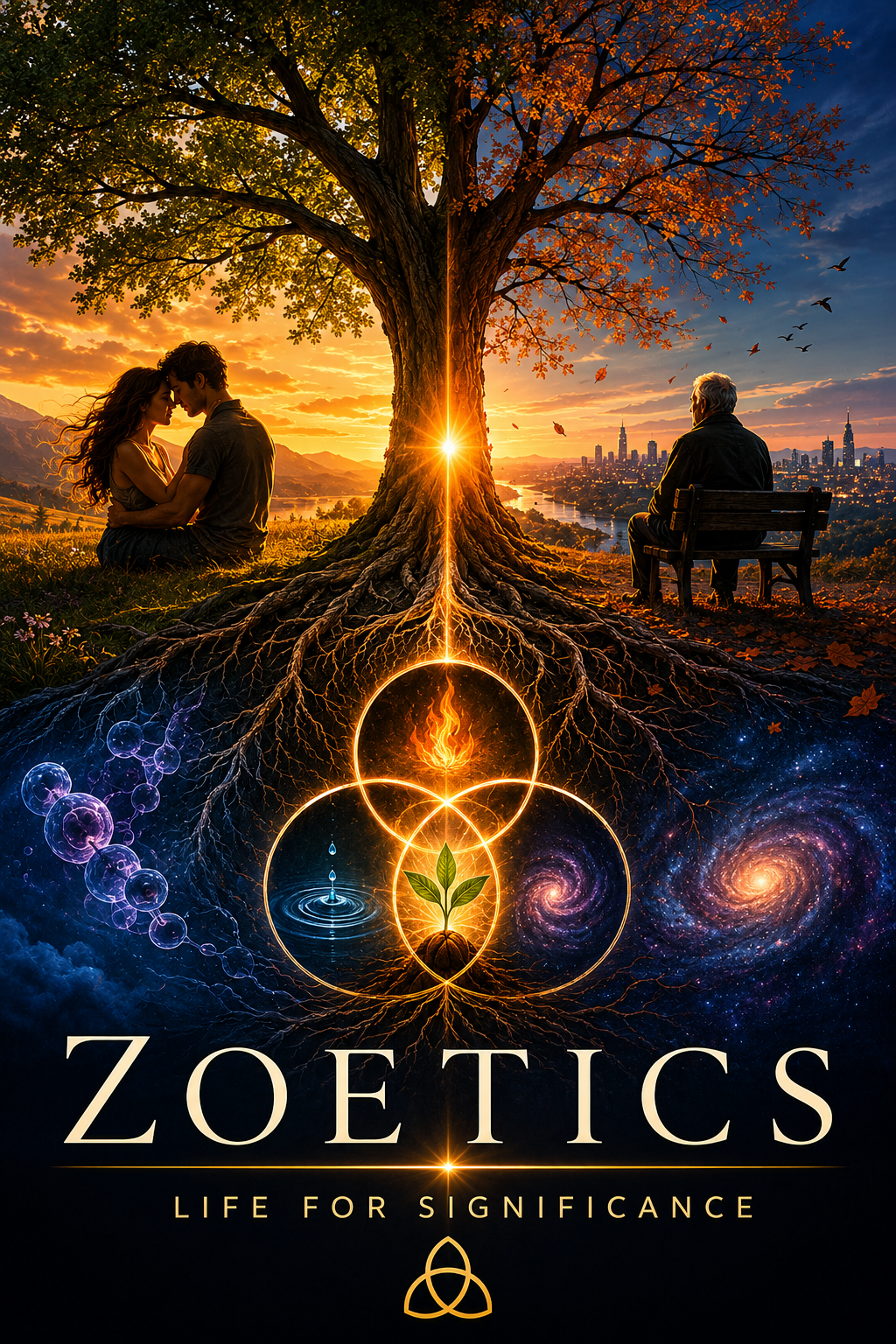
Write about the Zoetic as the ultimate principle of life seeking to produce more life
ChatGPT Prompt (condensed)
Modernity treats senescence as a problem to be solved.
The body slows.
The memory fades.
The joints ache.
The horizon shortens.
From the perspective of survival, aging appears as failure.
Yet this judgment smuggles in an assumption: that the purpose of life is to preserve the current bearer of life.
Biology itself suggests otherwise.
The Paradox of Aging
Aging is strange because life is not fundamentally organized around survival. Survival is merely one strategy among many. Alongside survival we find reproduction, development, metamorphosis, sacrifice, cooperation, teaching, and succession. Life continually spends existing forms in service of future forms.
- A caterpillar does not fail by becoming a butterfly.
- A seed does not fail by becoming a tree.
- A parent does not fail by being surpassed by a child.
- Why then should an elder fail by becoming an ancestor?
Embracing the Zoetic
The deeper pattern is not homeostasis but something larger. Let us call it the zoetic: that which increases the future capacity of life.
Viewed through this lens, senescence becomes intelligible.
The young naturally ask:
How do I continue?
The old increasingly ask:
How does what matters continue?
This is not merely a psychological adaptation. It is a shift in the center of gravity itself.
As long as survival dominates, significance remains optional. One can always defer the future in favor of the present self. Senescence gradually removes this illusion. Time becomes visible. Finitude becomes tangible. The question of succession can no longer be postponed.
What began as a life focused on persistence becomes a life focused on transmission.
The elder becomes zoetic not by competing with the young, but by blessing them.
Not by remaining indispensable, but by making themselves unnecessary.
Not by avoiding replacement, but by preparing worthy replacements.
The Glory of Senescence
Aging reveals that being superseded is not necessarily defeat.
Indeed, the highest achievement of a seed is to disappear into a tree.
The highest achievement of a teacher is to be surpassed by students.
The highest achievement of a scientific paradigm is to generate the discoveries that eventually replace it.
The highest achievement of a parent is not to remain the center of a child’s life, but to help the child become a center in their own right.
In each case, glory appears precisely where survival ceases to be the measure.
The Deeply Cruciform Pattern
The Cross is not the triumph of survival.
It is the triumph of fruitfulness.
The grain of wheat does not preserve itself. It falls into the earth and dies, and thereby bears much fruit. The point is not destruction but multiplication. Not loss but transmission. Not extinction but zoetic abundance.
Seen this way, senescence is not merely decline.
It is the hinge by which significance expands beyond survival.
It is the invitation to discover that life was never primarily about keeping the current form alive.
It was always about increasing the capacity for further life.
And when that becomes visible, being superseded ceases to look like failure.
It begins to look like glory.
Appendix I: Zoopoiesis as Significance Beyond Self-Preservation
The term zoopoiesis is proposed as a complement to, rather than a
replacement for,
homeostasis.
Homeostasis describes how living systems preserve viability in the
present.
Zoopoiesis describes how living systems increase the capacity for
further life.
The distinction is subtle but profound.
A living thing does not merely strive to remain alive. It also grows,
reproduces, teaches, transforms, cooperates, sacrifices, and eventually
relinquishes itself. These activities often reduce immediate survival
prospects while increasing the future possibilities of life.
This suggests that homeostasis, while indispensable, is not ultimate.
It is a local strategy employed by a larger process.
From Homeostasis to Zoopoiesis
The history of biological thought can be read as a gradual expansion of
what is being preserved:
- Homeostasis
preserves state. - Allostasis preserves
function through changing state. - Homeorhesis
preserves trajectory through changing function. - Autopoiesis
preserves organizational self-production.
Zoopoiesis asks a different question:
What are all these forms of preservation ultimately for?
Its answer is:
The preservation and expansion of life’s capacity to generate further
life.
In this sense, homeostasis is not opposed to zoopoiesis. It is nested
within it.
The organism survives because life requires bearers.
But life also requires successors.
And eventually it requires the bearers themselves to become gifts.
Historically, this essay draws inspiration from the work of Claude Bernard, Walter Bradford Cannon, C. H. Waddington, Humberto Maturana, and Francisco Varela, while extending their insights in a different direction.
The Zoopoietic Triad
Three recurring patterns appear throughout biology, culture, and
spiritual life.
Conatus
Following Baruch Spinoza, life strives to
continue.
This includes survival, repair, defense, resilience, and
self-maintenance.
Conatus is the domain of homeostasis.
Coitus
Life joins to generate further life.
This includes reproduction, cooperation, symbiosis, communion, and
mutual creation.
Coitus is not merely sexual. It names the broader principle by which
life exceeds the limits of isolated selves.
Transitus
Life passes into new forms.
This includes
metamorphosis, development, succession, paradigm shifts, death, and renewal.
Transitus is the principle by which continuity survives transformation.
Together these form a single zoopoietic process.
Life preserves itself. Life generates itself. Life transforms itself.
Senescence as the Zoopoietic Hinge
Senescence occupies a unique
position within this framework.
The young naturally orient around survival and achievement.
The old increasingly confront succession and transmission.
What begins as concern for self-preservation can mature into concern for
significance.
Senescence therefore acts as a hinge.
It shifts attention from:
How do I continue?
toward:
How does what matters continue?
This transformation is not accidental.
It is deeply zoopoietic.
The elder becomes fruitful not by avoiding replacement but by preparing
worthy successors.
The scientist becomes fruitful by nurturing students who will surpass
them.
The parent becomes fruitful by enabling independence.
The teacher becomes fruitful by becoming unnecessary.
In each case, significance expands beyond survival.
The Glory of Being Superseded
Within a purely homeostatic worldview, replacement appears as failure.
Within a zoopoietic worldview, replacement may be the highest form of
success.
- The seed is fulfilled by the tree.
- The caterpillar is fulfilled by the butterfly.
- The teacher is fulfilled by the student.
- The paradigm is fulfilled by the revolution it makes possible, in the sense described by Thomas Kuhn.
- The parent is fulfilled by the flourishing of the child.
To be superseded by what one has helped bring into being is not defeat.
It is fruitfulness becoming visible.
The pattern is deeply resonant with John 12:24, where the grain of wheat bears fruit by falling into the earth, and with Psalm 92:12–15,
where the righteous continue to bear fruit in old age.
This is the deepest meaning of zoopoiesis:
Life is not ultimately organized around preserving the current bearer of life.
Rather, life is organized around increasing the future capacity of life
itself.
- Survival serves this purpose.
- Reproduction serves this purpose.
- Transformation serves this purpose.
And significance emerges precisely when this purpose extends beyond the
self.
Appendix II: The Zoetic Triad of Generativity
If zoopoiesis names the process by which life increases its capacity
for further life, then the question naturally arises:
By what means does life accomplish this?
The answer proposed here is that life operates through three irreducible
modes of generativity:
- Conatus (Striving → Enduring) — continuity through persistence.
- Coitus
(Coming Together → Joining) — continuity through union. - Transitus (Crossing Over → Becoming) — continuity through
transformation.
Together they form the Zoetic Triad.
Most theories of life privilege one of these modes at the expense of the
others.
- Physiology emphasizes persistence.
- Evolutionary theory emphasizes reproduction.
- Developmental biology and cultural theories emphasize transformation.
Yet living systems require all three.
Life preserves itself. Life joins itself. Life transcends itself.
Conatus (Striving → Enduring)
From the Latin conatus (“striving,” “endeavor,” or “effort”).
Conatus is the impulse toward continued existence.
It includes:
- survival
- resilience
- healing
- adaptation
- self-maintenance
- homeostasis
- allostasis
Conatus protects the conditions under which future life remains
possible.
Without conatus, life cannot endure.
Yet conatus alone is insufficient.
A perfectly self-preserving system that generates nothing beyond itself
is ultimately sterile.
Question:
How does life remain viable?
Coitus (Coming Together → Joining)
From the Latin coitus (“coming together” or “union”).
Here the term is used in an expanded sense extending beyond sexuality to
include all forms of generative participation, cooperation, communion,
and mutual creation.
Coitus is the principle by which life exceeds the limits of isolated
individuals.
It includes:
- reproduction
- symbiosis
- cooperation
- communion
- teaching
- culture
- mutual creation
Biologically, coitus generates offspring.
Socially, it generates communities.
Spiritually, it generates participation in realities larger than the
self.
Coitus reveals that life does not flourish through isolation but through
relationship.
Without coitus, life remains trapped within its current boundaries.
Question:
How does life become more than itself?
Transitus (Crossing Over → Becoming)
From the Latin transitus (“crossing,” “passage,” or “transition”).
Here the term is elevated from simple transition to a first-class
principle of transformative novelty: the process by which life becomes
capable of what it was previously incapable of becoming.
Transitus is the principle by which life becomes capable of what it was
previously incapable of becoming.
It includes:
- metamorphosis
- mutation
- learning
- conversion
- innovation
- emergence
- scientific revolutions
- cultural renewal
- paradigm shifts
Conatus preserves.
Coitus combines.
Transitus creates.
Without transitus, life can survive.
Without transitus, life can reproduce.
Without transitus, life cannot evolve beyond its present possibilities.
Transitus is therefore the source of novelty.
It is the force by which life repeatedly escapes local optima and enters
larger possibility spaces.
In epistemology, transitus appears in paradigm shifts and Fourthness
reversals, where previously invisible realities become newly
intelligible.
In theology, transitus approaches what may be called Christing: the
continual transformation of existing forms into vehicles for deeper and
more abundant life.
Question:
How does life become capable of what was previously impossible?
The Triad Is Irreducible
None of these principles can be reduced to the others.
- Conatus without coitus becomes self-preservation.
- Coitus without transitus becomes repetition.
- Transitus without conatus becomes dissolution.
Life requires all three.
- Persistence grounds generativity.
- Union multiplies generativity.
- Transformation expands generativity.
The resulting tension is not a defect.
It is the engine of life itself.
Senescence as the Zoetic Hinge
Senescence becomes intelligible only in light of the full triad.
In youth, conatus dominates.
Life naturally centers upon survival, achievement, and growth.
As senescence unfolds, the limits of persistence become increasingly
apparent.
The question shifts.
From:
How do I continue?
To:
What will continue beyond me?
And finally:
What becomes possible because of me?
At this point coitus and transitus increasingly come to the foreground.
Attention turns toward transmission, succession, mentorship, blessing,
and legacy.
The elder’s deepest contribution is no longer personal persistence.
It is participation in futures they themselves will never inhabit.
Appendix III: Why Sex Begets Meaning
If the Zoetic Triad explains how life generates further life, it also explains why sex occupies such a unique place in human experience.
- Sex is not merely a biological function.
- Nor is it merely a cultural construct.
- Sex is where the three modes of zoetic generativity become inseparably entangled.
It is the point at which persistence, union, and transformation converge
within a single act.
This is why sex is never merely about sex.
The Semantic Burden of Sex
Most biological processes perform only one zoetic function.
Eating primarily serves
Conatus.
Learning primarily serves transitus.
Reproduction primarily serves coitus.
Sex is unusual because it participates in all three simultaneously.
It involves:
- desire
- vulnerability
- intimacy
- reproduction
- identity
- transformation
- succession
- mortality
- legacy
As a result, sex carries an enormous semantic burden.
It does not merely satisfy desire.
It asks what desire is for.
The Birth of Meaning
Meaning emerges whenever a system must navigate competing goods.
A world without tradeoffs contains information.
It does not contain significance.
Significance appears when something valuable can only be obtained by
risking or relinquishing something else.
This is why the Zoetic Triad becomes increasingly meaningful as life
becomes increasingly costly.
- Bacteria exchange genes.
- Animals sacrifice opportunities.
- Humans sacrifice futures.
Meaning arises because life becomes forced to choose.
Why Sex Matters
Sex is the first place where most organisms encounter a profound zoetic
tradeoff.
- Resources invested in reproduction cannot be invested in survival.
- Energy invested in offspring cannot be invested in personal growth.
- Commitments made to one future exclude countless others.
The organism discovers that life can only generate further life by
accepting loss.
This is not a flaw.
It is the foundation of significance.
Without tradeoff there can be optimization.
With tradeoff there can be meaning.
Sex as Zoetic Fulcrum
Sex therefore functions as a zoetic fulcrum.
Conatus asks:
How do I continue?
Coitus asks:
How do we continue?
Transitus asks:
What becomes possible that neither of us could become alone?
Sex sits precisely at the point where these questions become
inseparable.
This explains why sex is so frequently entangled with:
- identity
- morality
- shame
- love
- jealousy
- family
- covenant
- betrayal
- fertility
- parenthood
- transcendence
These are not accidental cultural associations.
They emerge because sex occupies a unique structural position within the
architecture of life.
Beyond Reproduction
Human beings instinctively recognize that sex means more than
reproduction.
The reason is not that reproduction is irrelevant.
The reason is that reproduction is only one manifestation of a deeper
principle.
Sex is fundamentally about participation in futures larger than the
self.
- Children are one such future.
- Communities are another.
- Families, cultures, traditions, institutions, and covenants are others.
At its deepest level, sex confronts the individual with a startling
possibility:
My life may matter most precisely where it ceases to be merely mine.
The Cruciform Structure
This is why sex and sacrifice remain strangely adjacent throughout human
history.
- Both involve the relinquishment of self-sovereignty.
- Both involve vulnerability.
- Both involve the creation of possibilities that did not previously exist.
- Both involve accepting costs that cannot be fully recovered.
The connection is not accidental.
Both are manifestations of the same zoetic structure.
Life becomes capable of further life by giving itself away.
The pattern is resonant with John 12:24, where the grain of wheat bears fruit through surrender rather than
preservation.
Why Sex Begets Meaning
Sex begets meaning because sex is the place where life first discovers
that generativity requires tradeoff.
- It is where desire encounters limitation.
- Where individuality encounters communion.
- Where persistence encounters transformation.
- Where self-preservation encounters significance.
The deeper mystery of sex is therefore not reproduction.
The deeper mystery is that life repeatedly becomes more itself by
becoming more than itself.
This is why sex is never merely biological.
It is zoetic.
And because it is zoetic, it is unavoidably semantic.
Sex does not merely generate life.
It generates meaning.
Appendix IV: Zoeism as Sacred Versus Ultimate
One of the most persistent confusions in human thought is the failure to
distinguish between what is sacred and what is ultimate.
The result is a recurring oscillation.
- Some traditions make too little sacred.
- Others make too much ultimate.
The first produces disenchantment.
The second produces idolatry.
A zoetic perspective offers a different possibility.
The Sacred
A thing is sacred when it participates in the generation, preservation,
or transmission of life.
Sacredness is therefore not a supernatural property.
It is a relational one.
A thing becomes sacred insofar as it contributes to the future capacity
of life.
Thus:
- sex is sacred
- family is sacred
- learning is sacred
- friendship is sacred
- science is sacred
- art is sacred
- worship is sacred
- sacrifice is sacred
Not because they are perfect.
Not because they are eternal.
But because they are generative.
They participate in zoopoiesis.
The Ultimate
The ultimate is different.
The ultimate is not a vehicle of life.
It is that for the sake of which all vehicles exist.
Confusion arises when sacred things are mistaken for ultimate things.
Confusion arises when sacred things are mistaken for ultimate things.
At that moment, generative goods become idols.
The sacred becomes self-referential.
Life ceases to flow through the form.
The form begins demanding preservation for its own sake.
The Structure of Idolatry
Every idol begins as something sacred.
- Families become sacred before they become tribal.
- Religions become sacred before they become oppressive.
- Nations become sacred before they become imperial.
- Traditions become sacred before they become stagnant.
The problem is rarely that the thing lacks value.
The problem is that its value becomes detached from its zoetic purpose.
An idol is not something valued too highly.
An idol is something valued independently of its capacity to generate further life.
The idol asks:
Preserve me.
The sacred asks:
Let life flow through me.
The Zoetic Criterion
A zoetic framework evaluates every institution, practice, relationship,
and belief according to a single question:
Does this increase the future capacity of life?
The question is neither reductionist nor relativistic.
It does not ask whether something is efficient.
It asks whether something is fruitful.
Fruitfulness is the measure.
- Not permanence.
- Not power.
- Not purity.
- Not popularity.
Sacred but Not Ultimate
This distinction transforms many cultural conflicts.
Sex is sacred.
But sex is not ultimate.
Family is sacred.
But family is not ultimate.
Religion is sacred.
But religion is not ultimate.
Science is sacred.
But science is not ultimate.
Even civilization itself is sacred.
But civilization is not ultimate.
Each derives its dignity from participation in a larger process.
None possesses dignity independently.
The Cruciform Pattern
The deepest test of sacredness is the willingness to be superseded.
A truly sacred thing does not merely preserve itself.
- It prepares successors.
- It creates possibilities beyond itself.
- It blesses futures it will never inhabit.
This is why the Cross functions as the anti-idol.
The pattern resonates with John 12:24.
Zoeism
Zoeism is therefore neither secular nor traditionally religious.
- It does not desacralize the world.
- It resacralizes it.
- Yet it simultaneously de-idolizes every finite thing.
Everything matters.
Nothing finite is ultimate.
Everything is sacred.
Only fruitfulness is ultimate.
Intellectual Lineage
Appendix V: Zoetic Theodicy
Every worldview must eventually confront the same question:
If life is good, why is there suffering?
Traditional theodicies attempt
to reconcile suffering with divine goodness.
A zoetic theodicy begins elsewhere.
It asks:
If the purpose of life is not survival, but the increase of life’s capacity for further life, what role does suffering play within that process?
The answer is uncomfortable.
Many forms of suffering appear not despite zoopoiesis, but because
of it.
The Problem of Tradeoffs
Meaning emerges only where goods compete.
A world without tradeoffs would contain information.
It would not contain significance.
The possibility of significance requires:
- vulnerability
- limitation
- uncertainty
- sacrifice
- loss
Without these, life could optimize.
It could not choose.
Without choice, there can be no meaning.
The same structure that makes significance possible also makes suffering unavoidable.
The same structure that makes significance possible also makes suffering unavoidable.
The Cost of Generativity
Every mode of the Zoetic Triad carries costs.
Conatus
Persistence requires struggle.
To live is to resist entropy.
The cost of existence is effort.
Coitus
Union requires vulnerability.
To love is to become capable of loss.
The cost of relationship is grief.
Transitus
Transformation requires relinquishment.
To become something new is to surrender something old.
- The cost of growth is death.
- Not necessarily biological death.
- But always the death of possibilities.
The death of former selves.
The death of roads not taken.
Why Evolution Hurts
Evolution is often celebrated for producing complexity.
Less frequently acknowledged is that evolution produces complexity by
producing failure.
- Every adaptation implies countless unsuccessful alternatives.
- Every species rests upon extinctions.
- Every success presupposes losses.
Life creates novelty through costly exploration.
Transitus generates possibilities by traversing dead ends.
A world capable of novelty is necessarily capable of tragedy.
Why Love Hurts
The same principle applies to love.
- Love is not painful because something has gone wrong.
- Love is painful because something has gone right.
The greater the participation in another life, the greater the
possibility of grief.
- A world without grief would be a world without attachment.
- A world without attachment would be a world without love.
The possibility of communion necessarily creates the possibility of
loss.
Why Senescence Hurts
Senescence appears cruel when viewed through the lens of survival.
Viewed through the lens of significance, it becomes intelligible.
The elder suffers because the body gradually releases its claim to
centrality.
- The same process that creates wisdom also creates limitation.
- The same process that creates legacy also creates decline.
Senescence is painful because significance is larger than survival.
The Cruciform Structure of Reality
The Cross reveals a pattern that appears throughout life.
Fruitfulness repeatedly emerges through relinquishment.
- Seeds become trees.
- Children replace parents.
- Students surpass teachers.
- Paradigms yield to revolutions.
- Civilizations transmit more than they preserve.
Everywhere life grows by giving itself away.
The Cross does not create this pattern.
The Cross unveils it.
It reveals the deepest structure of zoopoiesis:
Life becomes capable of further life through costly generativity.
The pattern is resonant with John 12:24.
Against Cheap Optimism
A zoetic theodicy is not an optimism.
It does not claim that all suffering is justified.
It does not claim that every tragedy serves a discernible purpose.
It does not deny evil.
- Some suffering destroys.
- Some suffering deforms.
- Some suffering should be resisted with every available resource.
The existence of zoopoietic suffering does not sanctify cruelty.
The existence of meaning does not excuse harm.
Against Despair
Yet neither does suffering possess the final word.
- The existence of pain does not imply the absence of purpose.
- The existence of loss does not imply the absence of significance.
- The existence of death does not imply the absence of life.
Zoopoiesis suggests a deeper possibility:
that reality is organized not around the preservation of present forms,
but around the continual generation of future possibilities.
The Zoetic Answer
The central question of theodicy is often framed as:
Why do bad things happen?
The zoetic question is different:
What kind of world is capable of producing meaning?
The answer appears to be:
- A world in which persistence, union, and transformation all matter.
- A world in which love can be lost.
- A world in which growth requires surrender.
- A world in which life can become more than itself.
Such a world inevitably contains suffering.
But it also contains significance.
And significance may be the reason life exists at all.
The deepest promise of zoetics is therefore not that suffering will
disappear.
It is that suffering need not be meaningless.
For meaning itself emerges from the costly work of life becoming more
life.
 Radically Happy
Leave a comment