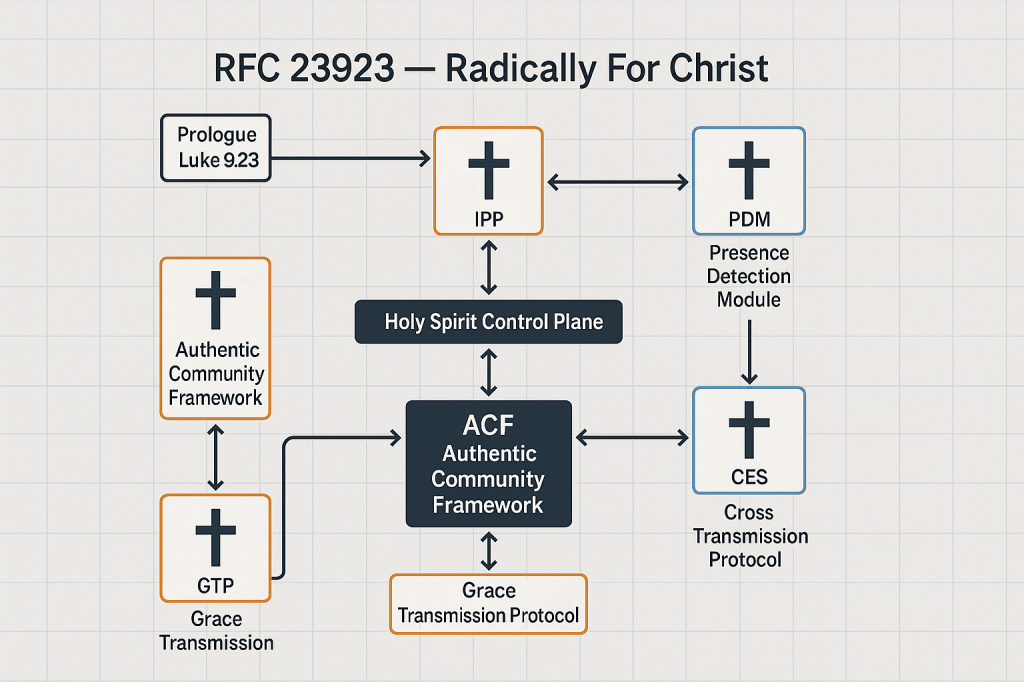
Create an IETF-style RFC from [this] transcript discussion of what it means to be Radically for Christ.
ChatGPT Prompt
Category: Informational
Author: Ernest Prabhakar
Status: Draft 1.0
Date: October 2025
Prologue — Luke 9:23
“If anyone would come after me, let him deny himself and take up his cross daily and follow me.”
— Jesus of Nazareth
1. Abstract
This document defines the concept and behavioral framework of being Radically For Christ (RFC) — a model for Christian discipleship emphasizing transformative intimacy with Jesus Christ, radical grace, and authentic community.
This RFC describes the core protocols, spiritual requirements, and best current practices for implementing Christ-centered transformation in individual and communal contexts.
2. Introduction
Modern Christianity often prioritizes external observance over internal transformation. Radically For Christ proposes a re-architecture of discipleship that centers on personal intimacy, radical love, and communal authenticity — consistent with the canonical Gospels and apostolic writings.
While grounded in Christian orthodoxy, this specification is interoperable across denominations and traditions, prioritizing Christ-likeness over institutional conformity.
3. Terminology
This document uses the capitalized key words MUST, SHOULD, and MAY as defined in RFC 2119.
- Christ: The incarnate Word of God, source of truth and salvation (John 1:14).
- Disciple Node: An individual follower of Christ implementing RFC-compliant behaviors.
- Community Network: A gathering of disciple nodes in mutual accountability and grace.
- Holy Spirit: The indwelling presence responsible for configuration, synchronization, and sanctification.
- Radical: From radix (“root”) — signifying depth and authenticity rather than extremism.
4. Core Requirements
4.1 Intimacy Priority Protocol (IPP)
Disciple nodes MUST prioritize a living, dynamic relationship with Christ above all other connections, even when this results in discomfort, ambiguity, or loss (Luke 14:26–27).
Failure to implement IPP renders the node spiritually uninitialized.
4.2 Presence Detection Module (PDM)
Nodes SHOULD train to perceive Christ’s presence in all circumstances, including ambiguity and suffering, and respond with obedience even without full understanding (Hebrews 11:8).
However, the system acknowledges periods of signal loss commonly described as the Dark Night of the Soul (cf. Psalm 22:1; John of the Cross).
Such experiences do not constitute protocol failure but temporary latency, requiring patience, prayer, and continued trust until reconnection.
4.3 Grace Transmission Protocol (GTP)
Nodes MUST emulate Christ’s radical love and forgiveness, particularly toward proximate or adversarial nodes (Matthew 5:44).
Grace packets MUST be sent unconditionally; acknowledgment by recipients is optional.
4.4 Cross Embrace Specification (CES)
Implementations MUST internalize the paradox of redemption through Christ’s suffering and death, recognizing this as the defining feature of divine protocol (1 Corinthians 1:23).
This module inverts conventional success metrics: victory = surrender; power = sacrifice.
4.5 Inward Transformation Engine (ITE)
Nodes SHALL de-emphasize ritual performance metrics and instead allow the Holy Spirit to execute sanctification processes conforming them to the image of Christ.
Performance logs MAY be public, but internal integrity checks are decisive.
4.6 Authentic Community Framework (ACF)
Networks MUST provide safe environments for transparency, repentance, and mutual growth, prioritizing spiritual integrity over social polish (Acts 2:42–47).
ACF nodes MAY exchange vulnerability tokens to build trust and strengthen synchronization.
5. Security Considerations
RFC 23923 implementations are vulnerable to religious-pride exploits, legalism injections, and hypocrisy trojans.
Mitigation includes continuous repentance cycles, humility audits, and persistent reliance on grace tokens provisioned through Christ’s atonement.
Firewalls of mercy are RECOMMENDED.
6. Deployment Considerations
RFC 23923 may be deployed in individual, familial, congregational, and vocational contexts.
Sustained uptime requires continuous prayer, Scripture immersion, and periodic synchronization events (e.g., Eucharist, confession, service).
Backward compatibility with prior Christian traditions is supported, though deprecated behaviors — hypocrisy, judgmentalism, self-righteousness — MUST NOT be re-enabled.
7. Acknowledgments
This specification builds on canonical documentation (The Holy Bible) and traditional mystical commentaries, notably The Dark Night of the Soul by St. John of the Cross.
Special thanks to the authors of RFC 2119 for the normative language that inspires this adaptation.
8. Conclusion
Being Radically For Christ defines a deep, costly, and transformative discipleship model that transcends superficial religiosity.
It embodies the revolutionary spirit of the Gospel through love, surrender, and authenticity.
Full implementation is RECOMMENDED for all who seek to manifest the Kingdom of God in real time.

 Radically Happy
Leave a reply to RFC-119666: The Human Generativity Interface (HGI) | Radical Centrism Cancel reply