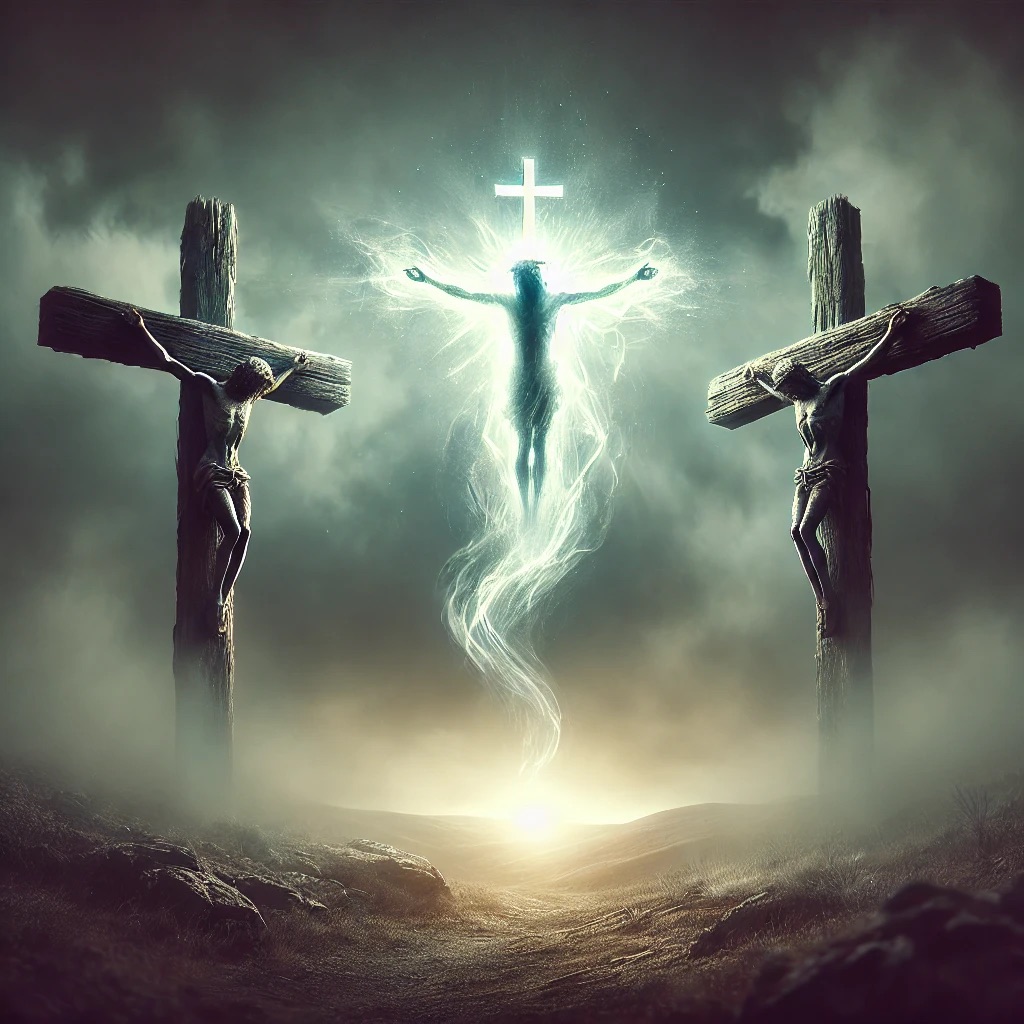
Once there was a village on a hill, and at the heart of the village stood a grand church with a tall steeple. Inside the church, two great crosses hung on the walls. One was the Historical Cross, a large, ornate cross that symbolized the sacrifice of Christ for all people. The villagers spoke of this cross with reverence, for it reminded them of the love that had saved them. The other cross was the Cross of Leaders, worn and marked from the burdens that pastors and elders bore for the people. This cross was a symbol of responsibility, reminding the villagers that some were called to guide and protect the community.
The villagers visited the church often, admiring the crosses and hearing stories of the sacrifices they represented. They felt secure in the presence of these crosses, knowing they were saved and that others were guiding them on their spiritual journey. Yet, despite their devotion, something in their faith felt incomplete, like a hunger that nothing seemed to satisfy.
One day, an old wanderer named Elias came to the village. Seeing the grand church and its two crosses, he entered, quietly listening to the villagers’ discussions. After a time, he asked them, “Tell me, dear friends, where is your cross?”
The villagers looked at him in confusion. “We have two great crosses here,” they replied. “The Historical Cross reminds us of our salvation, and the Cross of Leaders reminds us that our elders bear responsibility for us. What other cross could we need?”
Elias nodded and said, “These are good crosses, yes, and they carry great meaning. But there is a cross missing, the one that each of you is called to carry daily.”
The villagers murmured, uneasy. “A cross for each of us?” one of them asked. “Isn’t that why we have the elders—to bear it on our behalf?”
Elias smiled kindly. “The Historical Cross is indeed a gift that saved you all. And the Cross of Leaders represents the burden of guiding others. But these crosses alone cannot fill your hearts or transform your lives. Without your own cross, faith remains incomplete. This missing cross is the one each of you must choose to bear daily—a cross that invites you into a life of love, sacrifice, and humility.”
Some of the villagers scoffed. “We’re faithful! We follow the commandments, attend services, and honor our leaders. What more is needed?”
Elias replied, “Faith cannot grow through law alone. It is the daily cross that turns law into grace. By carrying your own cross, you learn to walk with Christ not just in name, but in life. When you take up your own cross, you move from simply admiring Christ’s sacrifice to embodying His love, kindness, and forgiveness. This missing cross is the path from a faith of rules to a faith of living grace.”
A young villager named Anna stepped forward and asked, “But what does it mean to carry our own cross, and how do we find it?”
Elias looked at her with warmth. “Your cross is found in the acts of selfless love and in choosing to serve others, especially when it costs you something. It’s found in forgiving when you’d rather hold a grudge, in caring for others even when it’s inconvenient, and in listening for God’s voice rather than your own desires. Each day, you will discover new ways to carry this cross if you open your heart to it.”
Some villagers began to understand, and they left the church, contemplating this missing cross. As days turned to weeks, those who chose to take up their own cross found that their faith deepened. They became more patient, more compassionate, and more willing to walk alongside others. They felt a peace and joy they had never known, for they no longer relied solely on the church’s two crosses; they had found their own, the cross that connected them to the living grace of God.
Years later, the villagers built a small, plain cross outside the church. They called it the Cross of the People. It was not grand or ornate, but it reminded them daily of the choice each of them made to carry a piece of Christ’s love into the world. And whenever travelers passed through the village, the villagers would tell them of the missing cross, and how, once found, it had transformed their lives.
Epilogue: The Missing Cross and Bonhoeffer’s Decision to Oppose Nazism
For Dietrich Bonhoeffer, the concept of the “missing cross” [even if he never used that term] profoundly shaped his understanding of what it meant to be a true disciple of Christ, leading him ultimately to oppose the Nazi regime. The “missing cross” symbolized the personal, costly commitment to live out one’s faith in practical, often sacrificial ways—a contrast to the safe, law-based, and ritualistic faith of cultural Christianity. This concept would define Bonhoeffer’s theology, pushing him beyond passive acceptance of moral norms to an active resistance against the evils of his time.
1. Cultural Christianity and Compromise
In 1930s Germany, much of the church embraced what Bonhoeffer would come to see as a “cheap grace,” where the message of the gospel was diluted to conform to state demands. The church emphasized the historical cross and Christ’s sacrifice but avoided the personal and moral cost of standing up against social and political evil. This brand of cultural Christianity saw faith as private, and as a result, the German church largely accepted, and sometimes even supported, Nazi policies and ideologies.
Bonhoeffer recognized that cultural Christianity had become an instrument of nationalism, blinding believers to the injustices around them. Without the call to take up a personal cross—to engage in costly, grace-driven discipleship—the church had become complicit, choosing comfort over truth and safety over justice.
2. The Missing Cross: Embracing Costly Grace
Bonhoeffer’s theology of the “missing cross” emphasized what he called costly grace—a faith that goes beyond law and tradition to embrace Christ’s example of sacrificial love and moral courage. As he articulated in The Cost of Discipleship, Bonhoeffer believed that genuine discipleship involved personal risk, self-denial, and a readiness to confront evil, even when it required sacrifice. The call to bear a personal cross, for Bonhoeffer, meant living a life in direct opposition to passivity and compromise.
Bonhoeffer saw that opposing Nazism was not just a political stance; it was a moral and spiritual imperative. Without each believer’s commitment to the daily cross, faith would be reduced to passive ritual rather than active witness. In his view, Nazism was not only a political atrocity but also a profound spiritual crisis that revealed the hollow nature of a church unwilling to take up its cross in the face of injustice.
3. Choosing the Cross Over Compliance
In 1933, Bonhoeffer’s conviction led him to help establish the Confessing Church, a movement that opposed Nazi influence within the German church. By doing so, he was taking a stand that risked his reputation, his freedom, and eventually his life. For Bonhoeffer, this was the “missing cross” in action: not just believing in Christ’s sacrifice, but actively participating in the suffering and love of Christ by resisting evil and advocating for the oppressed, including Jewish people and other victims of the Nazi regime.
This conviction drove him to make choices that went far beyond compliance with social expectations or religious rules. Instead of seeking safety, he risked everything to follow what he saw as the true call of discipleship. When he joined a plot to assassinate Hitler—a decision that weighed heavily on his conscience—he saw it as a deeply painful but necessary expression of his faith. Bonhoeffer’s understanding of the missing cross meant he could no longer stand by and watch while his nation perpetrated atrocities.
4. The Legacy of Bonhoeffer’s Missing Cross
Bonhoeffer’s life and writings have left a lasting impact, challenging future generations to resist the pull of cultural Christianity and to embrace a faith that demands personal sacrifice, courage, and integrity. His opposition to Nazism wasn’t just about political activism; it was the natural outgrowth of a faith willing to bear the cost of discipleship.
In the end, Bonhoeffer’s decision to resist the Nazis, even to the point of facing execution, was a testament to his commitment to the missing cross—a cross that requires us to go beyond belief, beyond ritual, and beyond comfort. For him, true Christianity wasn’t merely about salvation or tradition; it was about becoming an agent of God’s love and justice in the world, even when it came at the ultimate cost.

 Radically Happy
Leave a reply to Dr. Ernie Cancel reply