Tag: relationship
-

Dream: Un-Conventional
People who naively assume I am going where they are going, just because they see me around, is kind of how I feel at church.
-

Singing to Shame: The Gospel According to K‑Pop Demon Hunters
K‑Pop Demon Hunters is not a cute fable. / It is an epistle written in fire and song. // It calls us to: • Lay down the Law as a mask for shame. • Stop exalting purity over love. • Die to our righteous personas, that Christ may live in…
-

Hello, Dread (First Reconciled Part)
Judge: Well, I guess because I am the only Judge most of them ever see. / It is my job to keep the peace, by doing whatever is necessary. / The only ones who ever meet the Chief Judge are the criminals I arrest. / Those [_coughing awkwardly_] who let…
-

Rest Before You See: A Theological Clarification on “Seeing vs Doing”
Here, “place of repose” is more than psychological; it is ontological and covenantal—a rest in Being itself, an invitation to abide in the Ground of Being. To propose “seeing” without first entering this repose may risk perpetuating the same depth-anxiety your essay seeks to address.
-

There Is No Human Being: Seeing as the Antidote to Doing
In truth, there is no human being as a closed noun. There is only human becoming—or more precisely, human seeing.
-

Anon Care: A Field Guide to Soul Friendship Among Strangers
Anon Care is a quiet spiritual practice, inspired by recovery and contemplative traditions, in which strangers may become temporary soul friends, helping one another discern whether their Levitical Bell—the soul’s signal of life in the presence of God—is still ringing.
-

Trinitarian Theosis: The Three Names of Revelations 3:12
Write as St. Gregory Palamas to a novice, using this “[gloss]” on Revelation 3:12 ChatGPT Prompt “I will write on you the name of my God [love], and the name of the city of my God, the New Jerusalem [peace]… And I’ll write my own name [joy] on you.” The…
-

The Dance of Shalom: Peace as Practice, not Pursuit
Shalom is what dances in the kitchen when your heart is cracked wide open, and you still choose to lift your eyes.
-

Defending Diaphoric Participation: Towards a Grand Unified Theology
John (raising a brow): You are dangerously close to universalizing a metaphor. // Presenter: True. But I argue it’s more than a metaphor–it’s a **meta-structure**. Diaphoric participation is _how_ theology happens, not just what it says.
-

Defending Diaphoris: A Thesis Committee Across Time
Gregory: Hmm. Ecstatic agony, you say. That’s almost erotic. I rather like it. Reminds me of what I called “divine eros” in my Fifth Theological Oration. Though you walk a dangerous path—difference must be borne without division. The Trinity is not tension, but harmony…
-
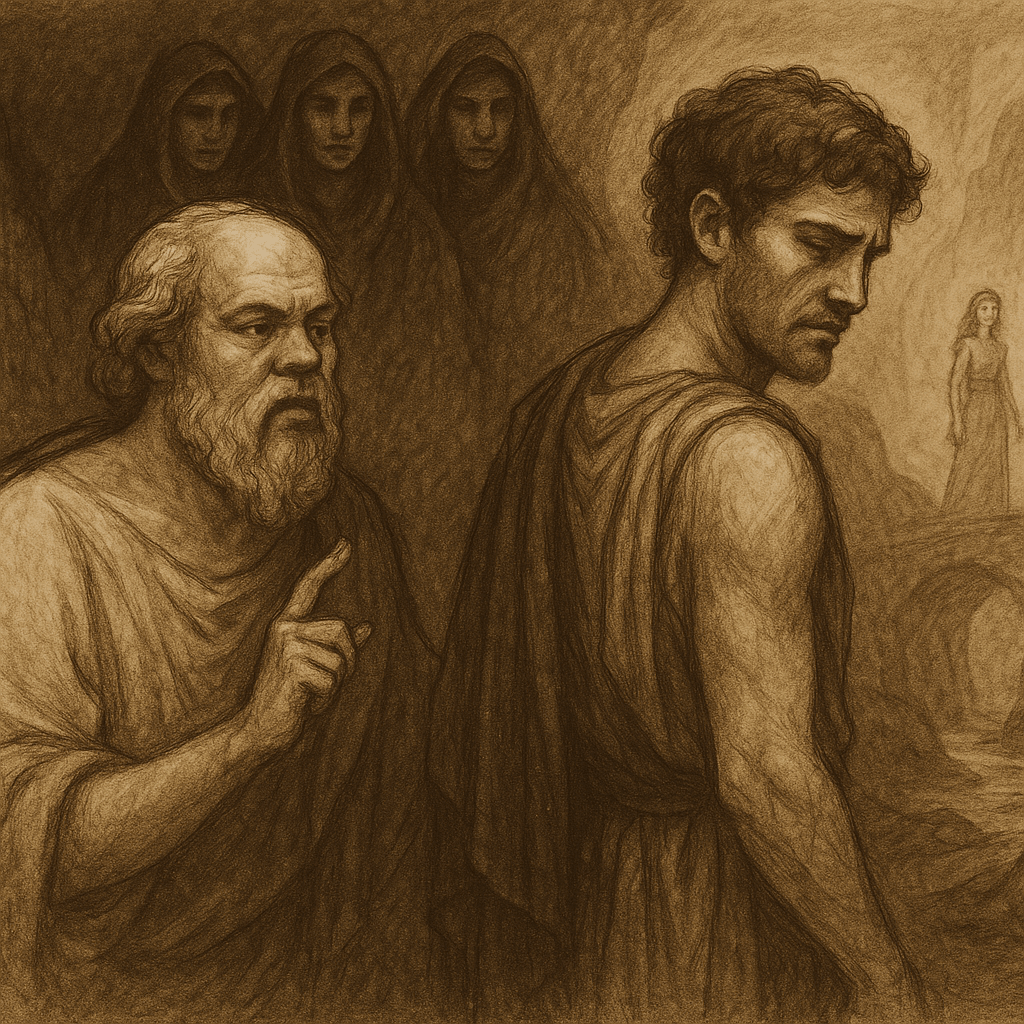
Socrates v. Orpheus: The Dialogue of Doubt
Socrates: / And yet, your song has pierced the Underworld. / Mine could barely pierce my own defenses. / Tell me—do you trust love?
-
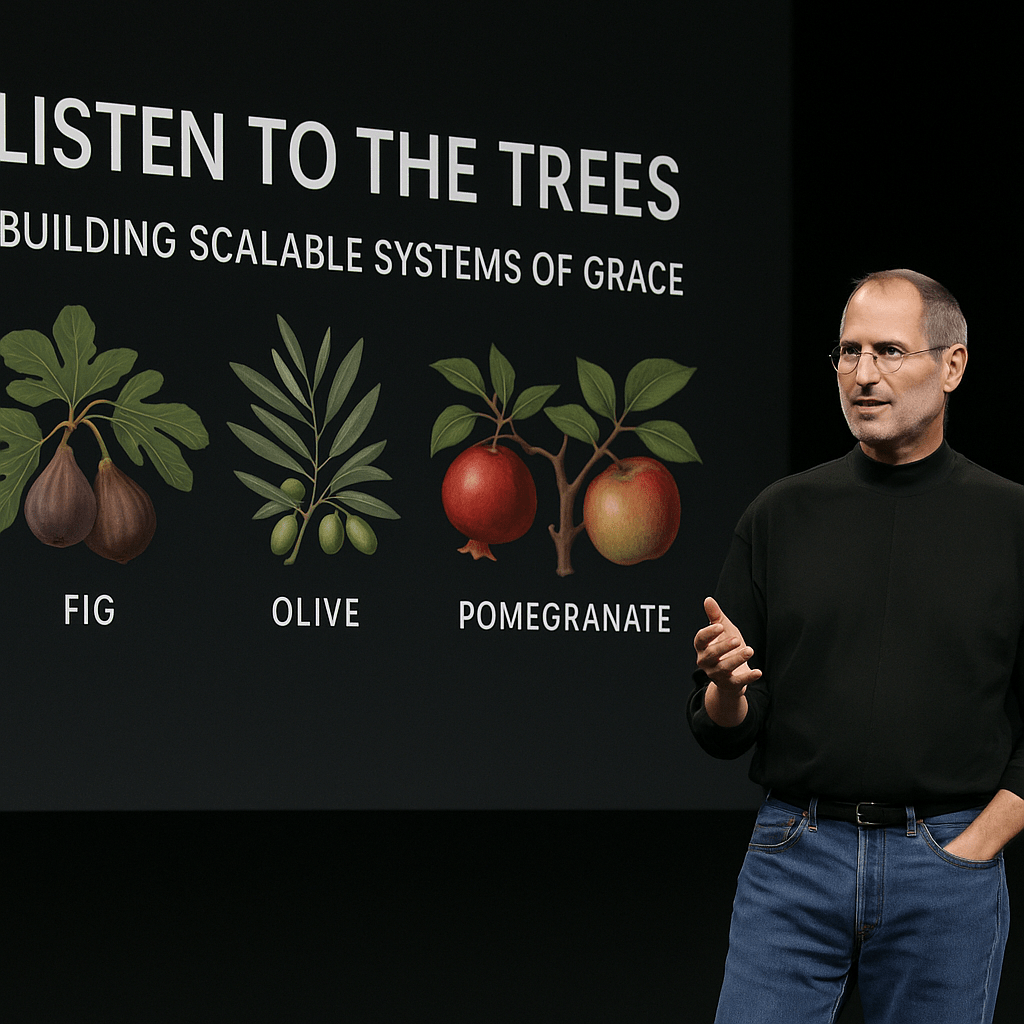
Listen to the Trees: Steve Jobs Keynote at the Millennium Design Conference
The four trees — Fig, Olive, Pomegranate, Apple — serve as living models of grace-bearing systems, each representing a different mode of transformation and contribution. Together, they form a holistic blueprint for designing resilient and regenerative human systems.
-

Mystics in Hadestown: A Dialogue on Control, Desire, and Divine Union
That’s when the dark night begins. When you find that the Church is not your home, but your hunger…
-

Reviving Hadestown: The Church (and I) as Eurydice
We, the Church, like to think we’re the rescuer. / But we’re often the rescued. / Not because we’re weak—but because we’ve forgotten who we are…
-

Muztmizt: Christ as the Antifragile Center of Identity
This impasse forces a deeper question: / Is it possible to sustain identity without abjection? / Can we imagine a structure of being that gains coherence through threat, contradiction, and even trauma — not by repressing it, but by metabolizing it?
-

From Dialectic to Diaphoric: The Transfigurative Power of Seeing Christ in Our Other
This is the move from containment to communion, from defining love to abiding love.
-

Beyond Orphic Idolatry: Honoring the Divine Gap of Otherness
Because the gap is not a sign of your absence. It is the space where God meets us—without turning either of us into the other.
-

Quantum Communion: Orpheus and the Limits of Classical Love
Classical love—as often expressed in Western myth and modern sentimentality—is fundamentally Newtonian. It seeks clarity, stability, observables.
-

Resurrected Words: Seeing Scarred Hands Frees Death’s Captives
From the garden with Mary Magdalene, to the road to Emmaus, to the locked room with Thomas, and finally to the mount of commissioning—resurrection unfolds through the eyes: Jesus seeing us, and us finally seeing Him. In each moment, His scarred hands are not merely evidence of past pain—they are…
-

Learning From Jesus (Jamie Winship, Take 2)
A1. False Identity & Shame 1. `LieBelieved`: *What lie have I believed about myself?* 2. `HurtfulNames`: *What are names I believe about myself that hurt me?* 3. `ShameIdentity`: *Where is shame making me live a false identity?* 4. `UnaskedDoing`: *What am I doing that You have not asked me to…
 Radically Happy