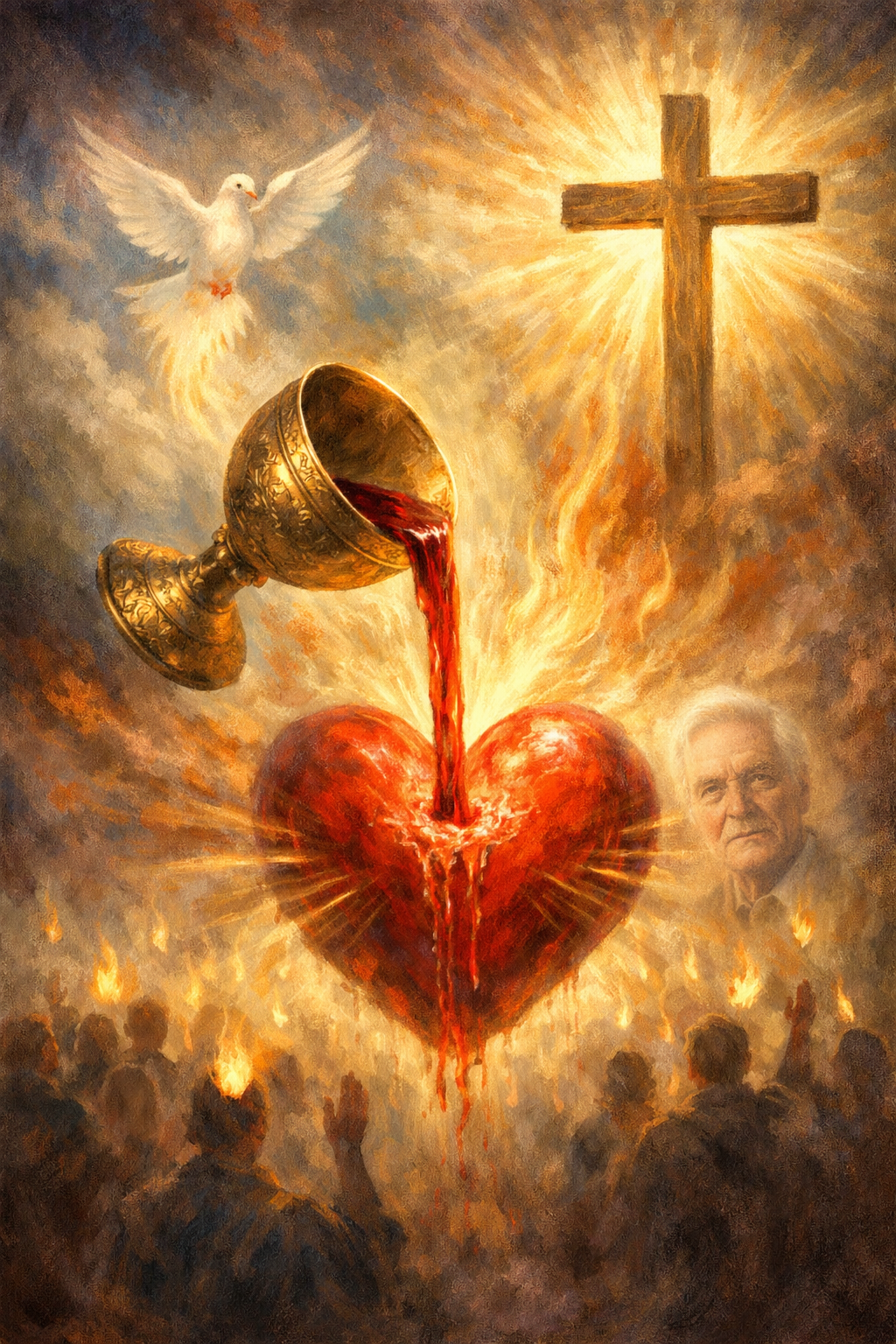
Write as a Pentecost missal on Romans 5:5 by Frederick Buechner (explaining/hyperlinking all the terms and verses)
ChatGPT Prompt (condensed)
“God’s love has been poured out into our hearts through the Holy Spirit who has been given to us.”
There are times when the old words still tell the truth but no longer tell it freshly. They are like coins rubbed smooth by too many pockets. “Love” is one of those coins.
We say God loves us, and we are right. But when Paul says that God’s love has been poured out into our hearts, you can feel him reaching for something wetter, riskier, more alive than the word we usually pass around.
He does not say the love of God has been explained.
He does not say it has been offered.
He says it has been poured into us.
Which sounds less like a lesson and more like a transfusion.
I. A word we didn’t know we needed: kenochi-agapē
Pronounced: keh-NO-kee ah-gah-PAY
A stitched word made from three Greek roots already living in the New Testament.
- κενόω (kenoō) — to empty oneself
- ἐκχέω (ekcheō) — to pour out, to spill completely
- ἀγάπη (agapē) — self-giving, divine love
Put together:
kenochi-agapē — love that empties itself by pouring itself out
It is what happened at the cross.
It is what happened at Pentecost.
It is what happens, mysteriously, in us.
II. The SOUL of it
SOUL:
- Self-emptying
- Other-centered
- Unconditional
- Love
Isaiah once wrote:
“He poured out his soul unto death.”
Isaiah 53:12
In Scripture, the soul is not what you hoard.
It is what love gives away.
God does not merely tell us He loves us.
He gives us His SOUL.
III. Why “transfusional” may be the least wrong English word
A transfusion is not symbolic. It is life from one body entering another so the other can live.
Jesus says at the table:
“My blood… poured out for many.”
Matthew 26:28
Peter says at Pentecost:
“He has poured out what you now see and hear.”
Acts 2:33
Paul says:
“God’s love has been poured out into our hearts.”
Cup. Throne. Heart.
One motion of love.
Transfusional love.
IV. The part we prefer not to notice
A transfusion quietly implies something else.
Room must be made.
Jesus says:
“Whoever loses his life for my sake will find it.”
Mark 8:35
Paul says:
“I no longer live, but Christ lives in me.”
Galatians 2:20
The gospel is not only God adding Himself to us.
It is God gently asking us to release what cannot carry His life.
Not destruction.
Exchange.
V. Pentecost, reconsidered
We remember wind. Fire. Languages.
But Pentecost is also this:
The life poured out on the cross
begins to beat inside ordinary people.
Not as an idea.
Not as a mood.
But as a love that seems not entirely our own.
You forgive when you had planned to stay angry.
You hope when you had given up.
You love when you had run out of reasons.
That is kenochi-agapē.
That is the SOUL of transfusional love.
VI. Prayer
Lord,
Empty us of what cannot carry Your life.
Fill us with the love You have poured out.
Let Your SOUL become the life within our souls.
Amen.
And if the word still feels new in your mouth, that may be the best sign of all.
Because the love it points to is older than language and newer than this morning.
Appendix I: Why Him
Why imagine this written in the voice of Frederick Buechner?
Because Buechner had a rare gift: he could speak about the deepest things of God with words that felt like they had mud on their shoes.
He trusted that when language begins to fail, you don’t retreat into clichés—you risk poetry, humor, and newly minted phrases that sneak past the defenses of the heart.
He believed:
Theology is what happens when experience collides with grace and tries to find words for it.
That is exactly what is happening here.
“kenochi-agapē.”
“Transfusional love.”
“The SOUL.”
These are not attempts to be clever. They are attempts to be faithful to the strangeness of what Romans 5:5 is actually saying.
Buechner spent his life doing this kind of work:
- Taking familiar verses and letting them feel unfamiliar again
- Letting humor and holiness sit at the same table
- Trusting that God’s grace often arrives in language that surprises us into seeing
He would not be embarrassed by a word like kenochi-agapē.
He would smile, try it out loud, and keep it if it made the truth clearer.
Most of all, Buechner understood that the gospel is not an explanation. It is an encounter.
And encounters often need new words.
A few of his works where this spirit shines
- Telling the Truth: The Gospel as Tragedy, Comedy, and Fairy Tale
- The Magnificent Defeat
- Wishful Thinking: A Seeker’s ABC
- The Sacred Journey
- Secrets in the Dark
- Listening to Your Life
Appendix II: Deriving the Word kenochi-agapē
This word did not begin as invention.
It began as close reading.
Paul writes:
“God’s love has been poured out into our hearts…”
Romans 5:5
The verb is:
ἐκκέχυται (ekkechytai) — from ἐκχέω (ekcheō)
to pour out, to spill, to empty completely
That same verb appears when Jesus says:
“My blood… poured out for many” —
Matthew 26:28
And when Peter says:
“He has poured out what you now see and hear” —
Acts 2:33
Cup. Throne. Heart.
One motion of love.
We then asked: what other Greek word names the posture that makes such pouring possible?
κενόω (kenoō) — to empty oneself
Philippians 2:7
Christ empties Himself.
Then He pours Himself out.
And what is the New Testament’s word for this divine, self-giving love?
ἀγάπη (agapē) —
Romans 5:8
The Greek pieces before the hyphen
If these had ever been compounded into a single patristic term, it might have looked like:
Κενοχυαγάπη (Kenochyagápē) — self-emptying, out-poured love
That word never appears in Scripture.
But its parts are everywhere.
Why the hyphen matters
Written as one word, kenochi begins to look like a word from another language and hides its roots.
The hyphen restores the meaning:
keno-chi agapē
You can see the motion:
Empty → Pour → Love
Anglicized gently for speech, it becomes:
kenochi-agapē
Why “transfusional” completes the picture
The Greek gives us the motion of love leaving God.
The English word transfusion helps us feel what happens next:
Life from one body entering another so the other can live.
Which traces the full arc:
- Blood poured out — Matthew 26:28
- Spirit poured out — Acts 2:33
- Love poured into hearts — Romans 5:5
A working definition
kenochi-agapē
The self-emptying, out-poured love of God
that becomes the inner life of the believer.
Or, as we named it:
The SOUL of transfusional love.
 Radically Happy
Leave a comment