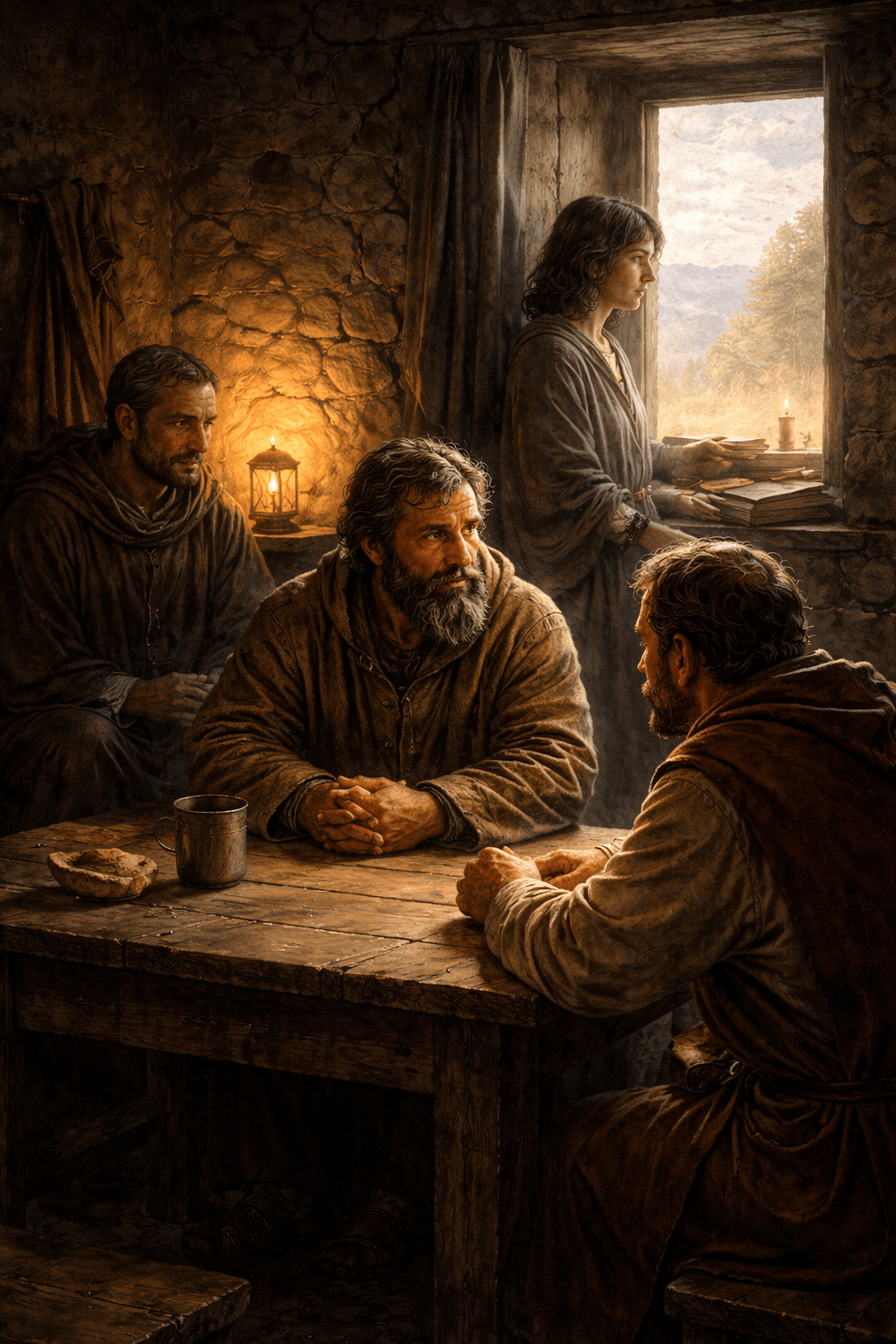
Have Leo Tolstoy write a skit characterizing Homo Abidus using three exemplars from the last millennium.
Dramatis Personae
- The Landowner — educated, anxious, well-intentioned
- The Pilgrim — poor, luminous, unpersuadable
(after Francis of Assisi) - The Woman at the Window — thin, severe, attentive
(after Simone Weil) - The Prisoner — bearded, quiet, immovable
(after Aleksandr Solzhenitsyn)
Time collapses. The setting shifts without explanation.
Scene I — The Question
Landowner
(pacing)
Everyone says the world is broken.
Some say it needs reform.
Some say revolution.
Some say better information.
Tell me—what must be done?
(The others are silent.)
Scene II — Francis
Landowner
(turning, hopeful)
You—why are you smiling?
Pilgrim
Because you are heavy,
and the truth is light.
Landowner
But the injustice—surely you see it?
Pilgrim
Of course.
That is why I carry nothing it can use.
Landowner
You gave up everything—to make a point?
Pilgrim
No.
I gave it up because it was in the way.
(He kneels and feeds a bird. The bird flies.)
Landowner
And power?
Pilgrim
(smiling)
It does not follow me anymore.
Scene III — Weil
A bare room. A window. Hard light.
Landowner
You look as though you are suffering.
Woman at the Window
Yes.
Landowner
And yet you do nothing to escape it?
Woman
I am doing the only thing that matters.
I am not lying.
Landowner
But meaning—hope—some explanation—
Woman
(gently interrupting)
Explanation is often violence done to reality.
Landowner
Then what remains?
Woman
Attention.
(She looks out the window. The Landowner cannot see what she sees.)
Landowner
Is that enough?
Woman
It must be.
Nothing else survives truth.
Scene IV — Solzhenitsyn
A prison barracks. Cold. Sparse.
Landowner
(whispering)
How did you endure this?
Prisoner
I stopped cooperating.
Landowner
You resisted?
Prisoner
No.
I obeyed reality.
Landowner
But the system—
Prisoner
—requires my inner consent.
That was the one thing it could not take.
Landowner
And if everyone did this?
Prisoner
Then the system would starve.
(Silence.)
Scene V — Recognition
The Landowner sits. Older now.
Landowner
You did not fix the world.
Pilgrim
No.
Woman
Nor did we explain it.
Prisoner
Nor did we replace it.
Landowner
Then what did you do?
(They look at him—not triumphantly, not sadly.)
Pilgrim
We stopped pretending.
Woman
We stopped asking permission to see.
Prisoner
We stopped living by lies.
Scene VI — The Name
Landowner
(quietly)
Is there a name for this way of being?
Pilgrim
Names are dangerous.
Woman
But sometimes necessary.
Prisoner
Call it what remains
when false necessity dies.
(A pause.)
Landowner
Homo Abidus.
(They do not object.)
Epilogue — Tolstoy’s Voice
The mistake of every age
is to believe that life depends on its arrangements.
But life depends only on truth.Those who discover this
do not become rulers of the world.
They become free of it.
Lights fade. No resolution. Peace.
What the Skit Enacts (Without Explaining)
- Exit without rebellion
- Truth without strategy
- Life without justification
This is Homo Abidus—
not the destroyer of modernity,
but the one who makes it unnecessary.
 Radically Happy
Leave a comment