Write in the voice of Max Lucado, by analogy to the original ending of Mark.
1. When the World Falls Quiet
Jerusalem once hummed with the music of worship. Then came the
ruin—walls breached, streets emptied, songs silenced. The poet of Lamentations walks through a city that feels like a tomb. Every stone seems to sigh. Every doorway remembers laughter that no longer lives there.
Maybe you’ve walked through ruins of your own: a broken relationship, a
diagnosis you didn’t want, a dream that didn’t survive the night. You know the hush of heartbreak. You know how absence can feel louder than presence.
This book is written for such places.
2. The Prayer That Refuses to Quit
Lament isn’t tidy. It’s not a polished Sunday prayer. It’s a clenched-fist cry:
“Where are You, God? Have You turned away? Have You forgotten us?“
The remarkable thing? God lets it stand. He doesn’t edit out the
questions. He doesn’t ask the poet to calm down or clean up. Scripture
gives grief a microphone.
Lament is faith with the tears still on its face.
3. The Mercy Hidden in the Middle
Right in the center—like a candle in a blackout—comes this quiet confession:
“Because of the Lord’s great love we are not consumed… His mercies are
Lamentations 3:22–23
new every morning.”
Notice the timing. Not when the city is restored. Not when the pain has
passed. Not when the problem is solved.
Morning mercies first appear in midnight places.
Hope doesn’t wait for circumstances to change. Hope shows up in the
rubble, taps you on the shoulder, and whispers, “Look again.”
4. The Tomb We Thought Was Final
The final chapter doesn’t wrap things up. No angels. No sudden sunbeams.
No miracle ending. The poet simply lays the sorrow before God and
whispers,
“Restore us… unless You’ve utterly rejected us.”
Lamentations 5:21–22
It sounds like the end.
But it feels like a pause.
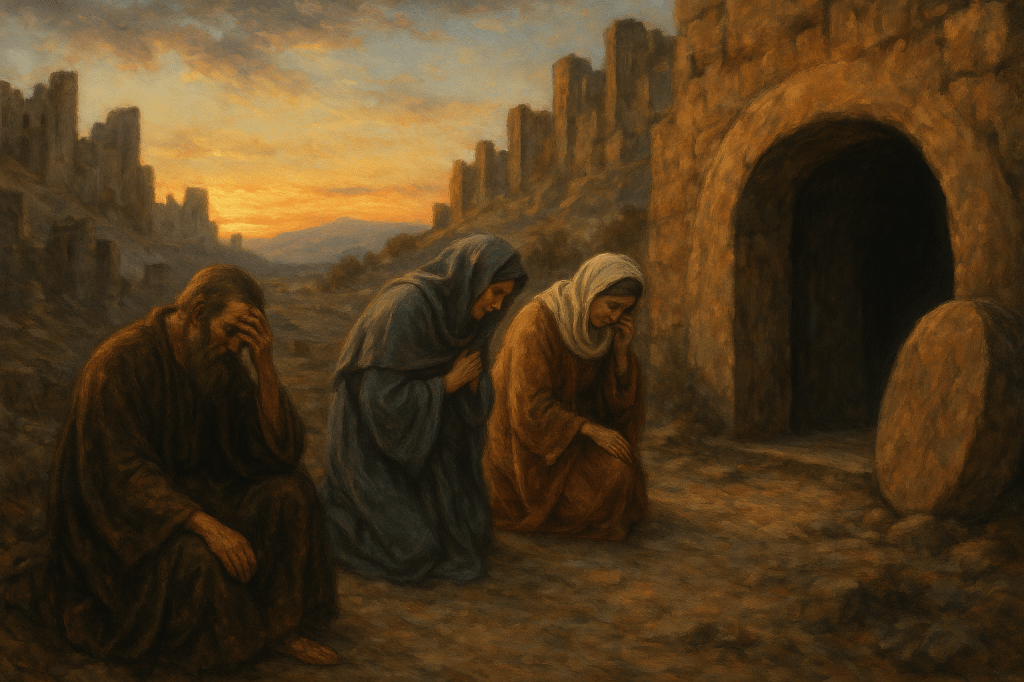
Much like the early women at the tomb in Mark’s Gospel—eyes wet,
hearts heavy—who arrived expecting to tend to a body and found instead
a mystery: the stone rolled back, the grave unoccupied, the silence trembling with hope. (Mark 16:1–8)
Lamentations ends at a tomb too. But listen closely: the grave is strangely quiet, as though something—or Someone—has already slipped out into the dawn.
5. The Gospel According to Tears
Here is the gospel according to Lamentations:
God meets us where the ache is deepest.
He walks the broken streets with us.
He receives every question we ask.
And in the very places we fear are dead, He plants the first seeds of
resurrection.
(Isaiah 53; Psalm 34:18)
You may not see the garden yet.
But the Gardener is already working.
(John 20:15)
6. A Final Word for Your Ruins
If your world feels like a chapter without a conclusion, know this: God
writes hope into unfinished sentences. Morning mercies are on the way.
The tomb is not the terminus. What feels like the end may be the
threshold of a new beginning.
Hold fast.
Light is rising.
And the God who renews mercies also restores lives.
 Radically Happy
Leave a comment