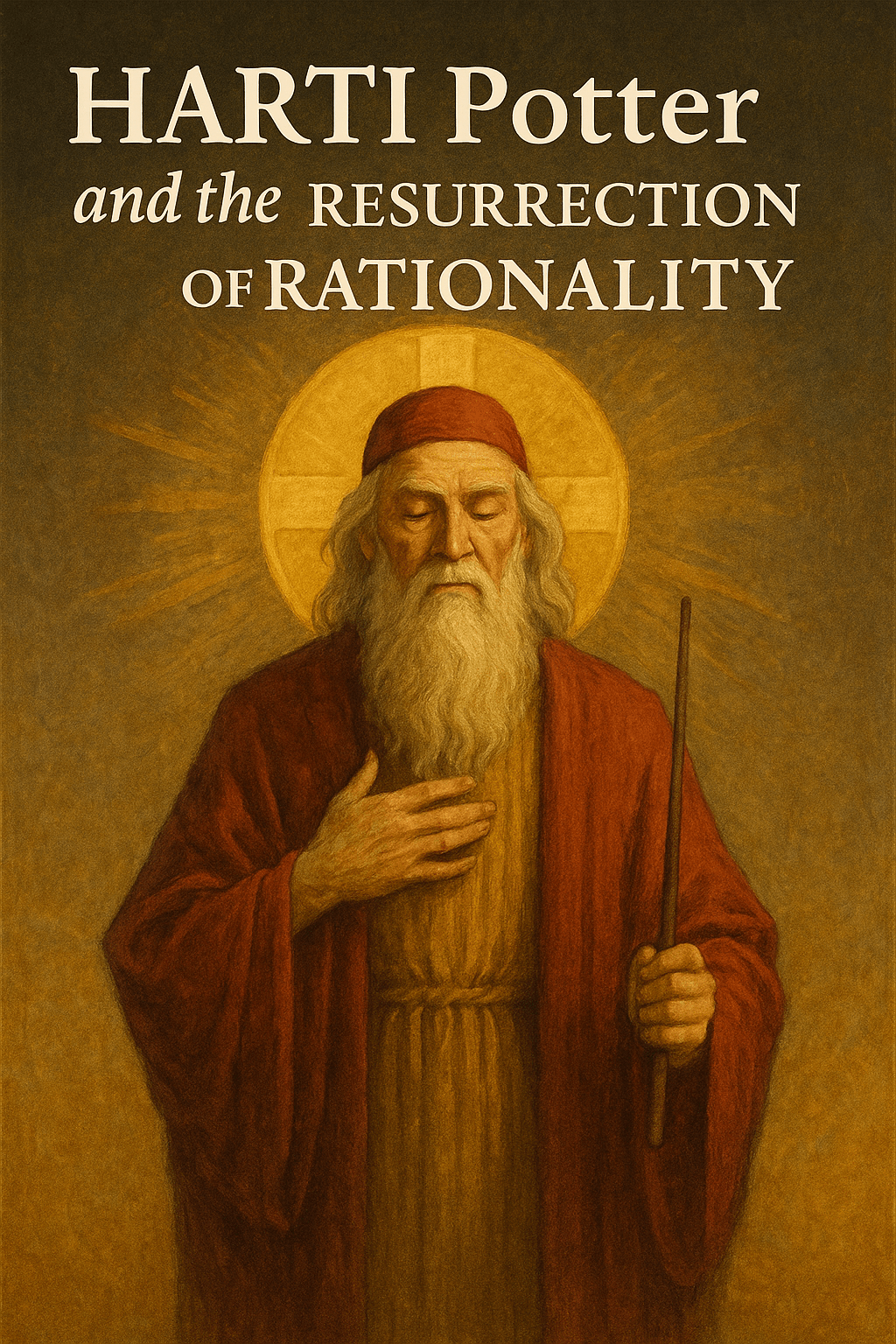
Write — not about the rationalists — but as my own “Dumbledore” journey as a Christian.
Ernie’s Prompt (to myself)
Confession: I originally intended this post to be “HARTI Potter and the Limits of Rationality“, as an AI-generated “fanfic” response to HPMOR (which I have not read) based on the HARTI hypothesis. But while working through that with ChatGPT, I realized that:
- Yudkowsky’s idolization of rationality was much more nuanced that I expected
- His treatment of Dumbledore’s mysticism hit painfully close to home
- The only way Dumbledore could save Harry — and show Harry how to save Voldemort! — was by transcending his own defense of irrationality.
- I had to a make a similar choice between cheap rhetoric and costly confession.
1. Christianity versus Rationality
The conflict isn’t as simple as both sides have portrayed it since the Enlightenment. The church’s persecution of Galileo owed as much to their defense of Aristotle as of Scripture (and both were arguably proxies for the chuch’s own authority).
From my perspective, religious movements always follow a similar arc (described elsewhere as the Silver Law of Theocracy). The short version is they only scale if they rationalize the irrational, but eventually that rationalization itself becomes irrational.
I initially intended this as a critique of the rationalist community, but it works even better as a confession of Christianity’s sins. And my own.
2. Embodiment vs Exposition
In this reading, Dumbledore’s failure in HPMOR is not his worship of the irrational. Rather, it is precisely that he rationalized that worship (in both senses of the word).
To me, this is the tragedy of 20th-century Christianity. I was raised fundamentalist, and still maintain emotional ties to that community. But what I later realized is that it wasn’t primarily concerned with defending the central mystery of the resurrection. Rather, it was obsessed with the”fundamentals” that conservatives rallied around a century ago in order to protect that mystery from the onslaught of modernism.
The distinction is subtle but profound, and even now I struggle to put it into words. The best I can do is point to the metaphor of the bronze serpent: every tool God genuinely provides to save us must necessarily draw from the idioms we can understand; but always falls short of His true glory, and ultimately becomes a snare that obscures what it was intended to reveal.
3. Rationalists as neo-Christians
I must confess: I am jealous of the rationalists. In many ways, they are better Christians than Christians. In particular, they are publicly committed to living a moral code that others find weird, but grudgingly respect and occasionally copy.
This is the social role Christianity held from Roman times through the anti-slavery crusades. Even if the institutional church got coopted, Christian reformers were the light that sparked the renewal.
Now? Not so much.
What happened?
4. The End of Christianity
Jesus didn’t invent the term “Christian.” That came later, and was arguably popularized by the
Apostle Paul.
My belief is that Christianity — of necessity! — ended up defining itself as a culture to promulgated, rather than a Christ to be followed. That is perhaps the only way to raise children, or run a country.
Until it isn’t. Then what?
5. The Great Surrender
I think we should give up.
Christianity has had a great run, perhaps exceeded only by Judaism.
But just as the apostles declared that Gentiles no longer need to become Jews to approach God, I think we need to stop requiring people to become Christian to know Christ.
I do not mean to downplay the horror of this. Despite everything, I still believe Christianity is the underlying thread that holds modern civilization together.
Which is precisely why it has to die.
Forget the fact that the Christianity we enjoy today was enabled by the destruction of Jerusalem, Rome, and Christendom — and deserves no better fate.
The real reason to embrace that reality is to follow Christ. Not as some historical event to honor, but as a living Person who calls us to deny ourselves, take up our cross, and follow Him. All the way — including being crucified with Him in His death, so we can share in His resurrection power.
We can no longer use our inherited moral authority to tell the world it is true. We have to show them.
6. A Better Compromise
So my invitation, scandalous as it is, is to do what Christians have done for millennia: endorse a secular power that we believe will create a context where we can propagate Christ.
Specifically, bless Rationalism.
More: confess that the real reason we recoil from their ultra-progressive trans-humanist agenda is not because we are holding onto Christ; but to our religion.
7. Making it Personal
I’ll be honest. What I find most foolish and offensive about rationalism is their lack of respect for embodiment. Their worship of (and terror at) superintelligence feels like a colossal category error, that grossly misunderstands the centrality of relationships, or even what it means to be alive.
And yet: their practice is often the opposite of their preaching.
And so is mine.
From what I can see, they actually do a better job of embodying their values than I do. Their LessOnline conference sounds not just more intellectually stimulating than any comparable Christian gathering, but far more relationally honest.
To be sure, I see them in danger of replicating all the same mistakes we made: performative morality, self-shaming legalism, insular groupthink.
But I can’t fix that. Christianity can’t save them from that, when we can’t even save ourselves.
If I really care — and to be perfectly honest, I’m not sure I do — the only way forward is to do what Jesus did.
Empty myself.
Become as one of them.
See the world through their eyes.
Let them see me
Accept me
Argue with me
Reject me
Close enough that it hurts
Maybe they will kill me
Or just maybe
This time
I will die to myself
Fast enough
They won’t have to kill me
To see Christ raised from the dead
Written on my iPhone, without AI assistance.
Except for the featured image.
 Radically Happy
Leave a comment