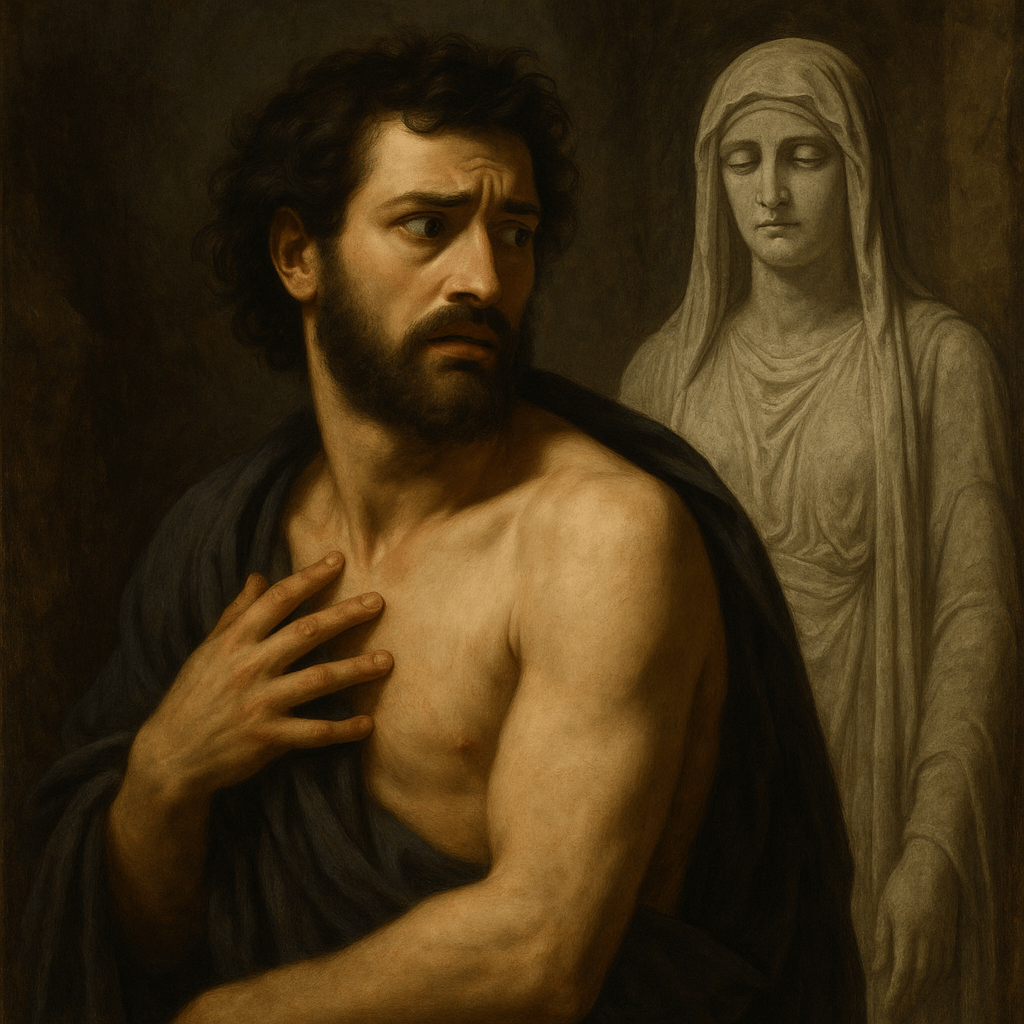
Write this starting with the example of Orpheus, whose robust love for what he could see in Euridyce was powerful enough to redeem Hades, yet doomed her.
ChatGPT Prompt
1.0 The Tragic Paradox of Orpheus
In the myth of Orpheus and Eurydice, we encounter a love so fierce and focused it dares to challenge the realm of the dead. Orpheus, armed only with his lyre and longing, charms Hades himself—redeeming the irredeemable. His music, his devotion, his sheer aesthetic purity seem to break reality’s rules. He is granted the impossible: Eurydice may return, on one condition—that he not look back.
But he does. Why?
His love is robust, potent enough to shake the underworld—but it is not antifragile. It cannot survive uncertainty. He needs to see Eurydice to know she is real, that she is his. His love depends on confirmation. And so, by gazing upon the image he longs for, he shatters the reality he was promised.
Orpheus offers us a tragic parable: the attempt to capture the divine in the visible, the tangible—the idol—ultimately results in its loss.
2.0 Graven Images and the Need to See
Idolatry begins with good intentions: to honor, remember, or relate to the divine. But it collapses into error when the representation becomes the reality. The human need to see, to hold, to know—to “look back”—drives us to create graven images. Yet by doing so, we reduce the mystery of God to the certainty of form.
This is not merely theological error; it is epistemic fragility. An idol is a brittle container for transcendence. It demands that the infinite become finite, the invisible made visible, the unspeakable rendered manageable.
Just like Orpheus could not trust the unseen Eurydice, we often cannot trust the invisible God. So we reach for a god we can grasp. But what we create then is no longer God—it is a concept, a system, a statue, a theology. A projection.
3.0 The Antifragile God
God, as understood in Scripture and mystic tradition, is not fragile—not even merely robust. God is antifragile: not only surviving disorder but growing through it. The true God is not threatened by death, ambiguity, or paradox. In fact, divinity is most revealed through them.
To worship such a God requires vulnerability, not certainty; participation, not possession. Antifragile worship embraces mystery, allows for darkness, and trusts even when unseen. It does not “look back” for proof. It walks forward in faith.
Graven images are the opposite. They lock God into a past form. They cannot grow, adapt, or resurrect. Like Eurydice fading back into Hades, the divine disappears the moment we grasp too tightly.
4.0 Idolatry as Control
At its heart, idolatry is a desire for control: a way to manage the uncontrollable. Whether through doctrine, ritual, politics, or art, we seek to make God predictable. We craft systems that guarantee grace, prosperity, belonging. We reduce the Creator into a cosmic vending machine or ideological mascot.
But an antifragile God cannot be controlled. God resists domestication. God calls us to the wilderness, not the shrine. To follow such a God is to embrace risk, loss, even death—knowing that resurrection lies beyond.
5.0 Toward a Non-Idolatrous Worship
The antidote to idolatry is not iconoclasm but kenosis—the self-emptying way of Christ. To worship without idols is to allow God to be God: unknowable, untamable, present.
This means:
- Letting go of images, doctrines, or expectations that keep God small.
- Accepting ambiguity as holy ground.
- Engaging mystery not as a problem to be solved but a Presence to be entered.
Like Orpheus, we are invited to trust love enough to not look back. Not because the seen is evil—but because the unseen is greater.
6.0 Conclusion: Faith That Faces Forward
The tragedy of Orpheus warns us: what we most long for can be lost when we demand it on our own terms. Graven images, literal or conceptual, betray a lack of faith in the God who transcends them.
To worship the antifragile God is to embrace the invisible, walk with the unknowable, and trust the One who thrives in the very chaos we fear. It is to turn away from the image—and walk forward in faith.
 Radically Happy
Leave a comment