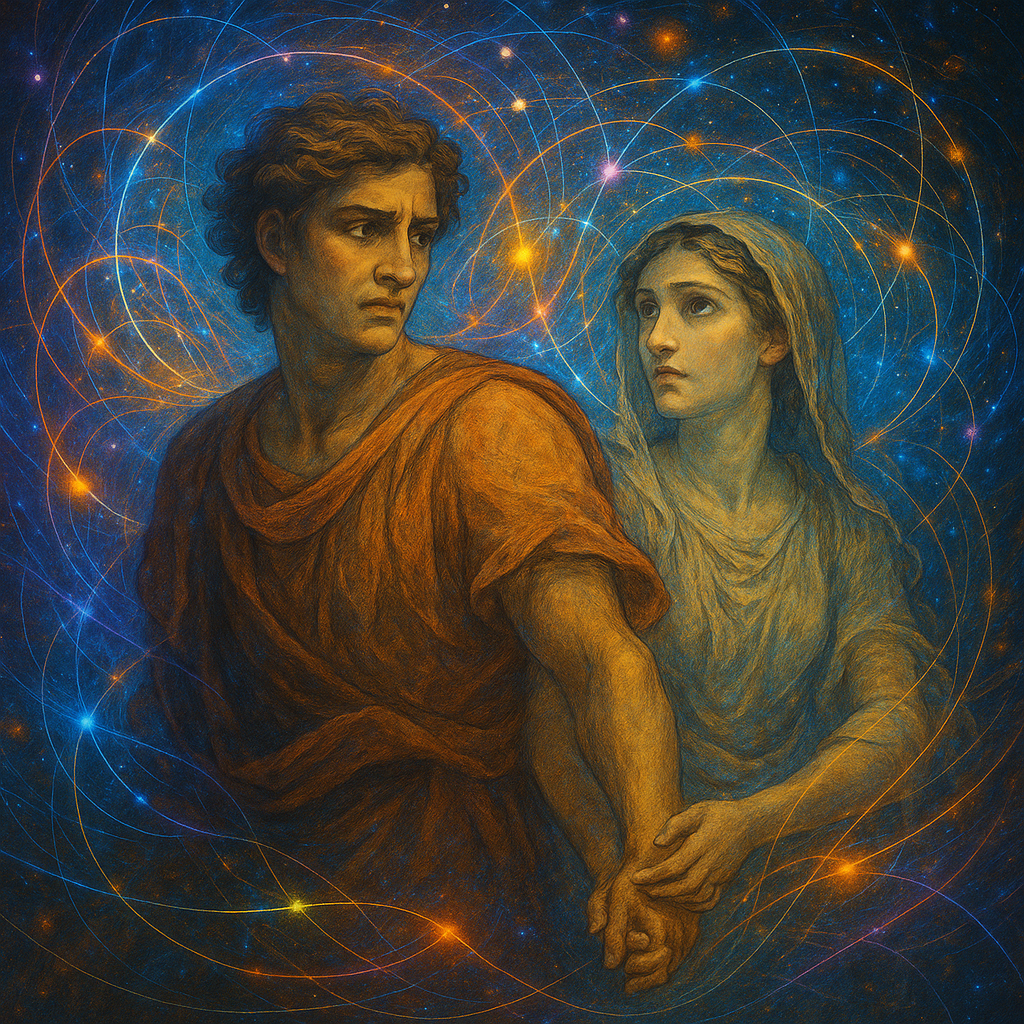
ChatGPT Prompt
As Polkinghorne, write this about holding the trinitarian tension between fusion (monism) and independence (pluralism).
A theological reflection on myth, physics, and Trinitarian love
Introduction: The Tragedy of Orpheus as Theological Parable
The myth of Orpheus is not merely a story of romantic misfortune. It is a liturgy of metaphysical error—an experiment in classical love that collapses under its own epistemic rigidity. Orpheus sought union without allowing for otherness, demanded presence where only trust would suffice, and destroyed communion in his pursuit of confirmation.
As a physicist-priest, I propose a re-reading of Orpheus through a Trinitarian quantum lens:
An invitation to reimagine love not as monism (complete fusion) nor pluralism (complete independence), but as quantum communion—the mysterious third way, a dance of unity and distinction modeled by the Triune God.
Classical Love: The Collapse into Control
Classical love—as often expressed in Western myth and modern sentimentality—is fundamentally Newtonian. It seeks clarity, stability, observables. It says:
“I love you if I can be certain of you.”
Orpheus embodies this fallacy. His love for Eurydice is grand, even heroic, but built on a faulty metaphysical foundation: fusion without freedom. He descends into Hades not to meet her as other, but to reclaim her as same—a restoration of his wholeness, not hers.
The rule of Hades—“Do not look back”—is not arbitrary. It is sacramental. It forces Orpheus to relinquish observational control. To love in absence, by faith. In quantum terms: to let the system evolve unmeasured.
But Orpheus cannot hold the tension. His need to verify collapses the entangled state. He turns, and with that glance, he converts mystery into tragedy.
The Trinitarian Alternative: Neither Monism Nor Pluralism
At the heart of Christian metaphysics lies a tension more profound than any myth:
One God in Three Persons (Matthew 28:19).
Unity without collapse. Diversity without division (John 17:21).
- Monism insists on fusion: love means sameness, absorption, loss of self.
- Pluralism insists on separation: love means distance, autonomy, detachment.
- The Trinity reveals a third way: perichoresis—mutual indwelling without erasure.
This is the model Orpheus lacked. He knew the descent (kenosis, see Philippians 2:6–8), but not the dance. He grasped at Eurydice as if love required certainty rather than communion—and thus lost both.
Quantum Communion: A Theological Metaphor
Quantum physics, far from dismantling theology, offers a compelling metaphor for divine love:
- Entanglement models real relationship: two entities remain correlated even at distance, but without collapse into sameness.
- Superposition resists binary outcomes: presence and absence may coexist until collapsed by observation.
- The Observer Effect cautions against control: measuring a system can irrevocably alter it.
In Trinitarian terms:
The Father is not the Son. The Son is not the Spirit. Yet they dwell in one another, eternally.
Love, then, is not the demand for certainty but the capacity to abide in tension. To hold presence without proof, otherness without fear.
Eurydice as the Beloved Other
In Orpheus’s story, Eurydice is the silent one. The followed. The lost. But in the Trinitarian frame, she symbolizes more than romantic love: she is the beloved Other—the human soul, the Church, the stranger, the God-who-waits.
Orpheus’s sin was not his love, but his unwillingness to let her be Other. His glance was not a betrayal of her, but of the relational fabric itself.
True communion requires trust that does not collapse mystery.
Conclusion: Toward a Quantum Theology of Love
The tragedy of Orpheus reveals the failure of classical love—a love that demands sameness, visibility, and control. The Trinity, and quantum reality, offer a deeper wisdom:
Communion is not fusion.
Faith is not blindness.
Love is not certainty—it is fidelity in tension.
To love well is to live Trinitarianly:
To let the Other be, and yet belong.
To hold absence as presence.
To trust the unseen walk behind us—without turning back.
“Quantum communion” is not a theory of particles or gods—it is the way of Love that flows from the Triune heart of reality. Let us walk it, unseeing but not unheld.”
 Radically Happy
Leave a comment