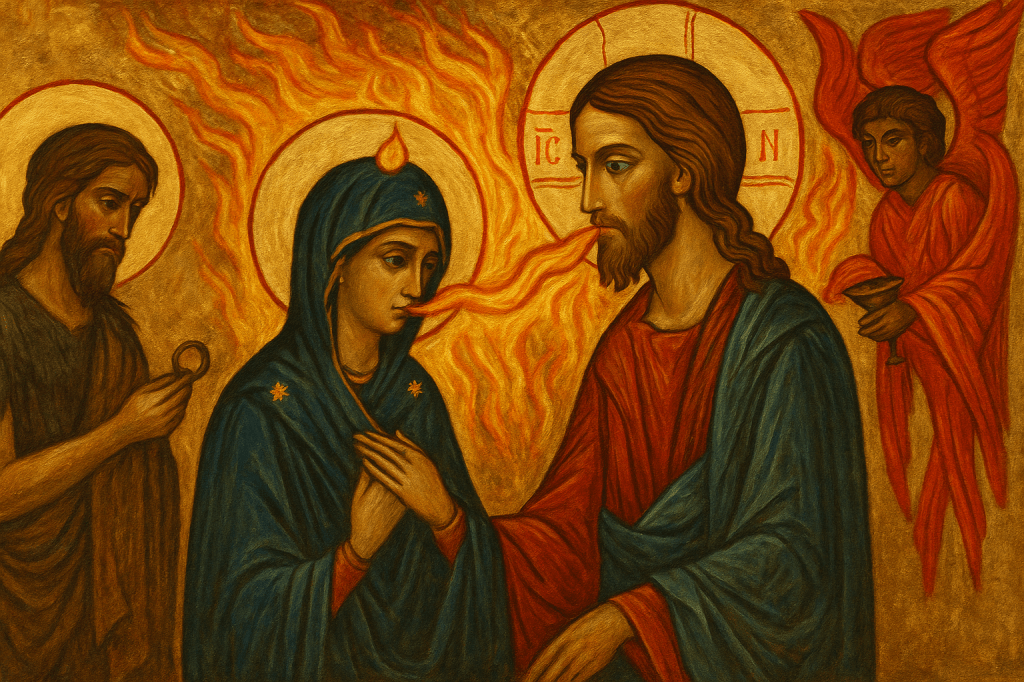
Pentecost is often seen as the birthday of the Church or the dramatic arrival of the Holy Spirit. But viewed through the lens of covenantal intimacy, it becomes something far more tender and more terrifying: the engagement of the Church to Christ, sealed not with a ring, but with a fiery kiss.
The Bridal Covenant
Scripture presents God’s relationship with His people in deeply marital terms. At Sinai, Israel was not merely liberated but wedded to the Lord. Rabbinic tradition sees the giving of the Torah on Mount Sinai—as celebrated during Shavuot—as a marriage covenant: God as Bridegroom, Israel as Bride, Torah as ketubah. The thunder, cloud, and flame of Sinai were not just displays of power, but theophanic tokens of divine love.
Pentecost, occurring on the same feast, is the New Covenant’s betrothal moment. But now the covenant is not written on tablets of stone but inscribed by fire upon human hearts (2 Corinthians 3:3). The Spirit descends not with distant law, but with intimate presence. This is not the full marriage—Revelation reserves that for the wedding supper of the Lamb—but it is the unmistakable pledge: Christ is claiming His Bride.
The Spirit as Engagement Fire
In Paul’s letters, the Holy Spirit is described as the arrabon—a Greek term for down payment or earnest pledge (2 Corinthians 1:22, Ephesians 1:14). This is the divine version of an engagement ring, not ornamental but ontological. The Spirit is not worn on the finger but burns within—alive, holy, unquenchable. This fire does not merely symbolize love—it is love: purifying, empowering, indwelling.
Unlike gold, this fire is antifragile. It does not fade with time or wear with trials. Instead, persecution fans it. Suffering refines it. The Church’s afflictions become fuel for a deeper flame. This is no fragile trinket—this is an engagement that consumes.
The Fiery Kiss: Isaiah’s Vision Revisited
Nowhere is this image more vividly foreshadowed than in Isaiah 6. The prophet, overwhelmed by God’s holiness, cries out in unworthiness. In response, a seraph flies to him with a burning coal from the altar, and touches it to his lips. “Your guilt is taken away, and your sin atoned for,” the angel declares (Isaiah 6:7).
This is no gentle blessing. It is a searing kiss—a divine purification that readies Isaiah for intimacy and mission. It is this same fire, now multiplied, that touches the apostles at Pentecost in Acts 2. The Spirit’s descent is not only the fulfillment of Joel’s prophecy but the collective re-enactment of Isaiah’s encounter. It is as though God leans in, and with tongues of fire, kisses the lips of His Bride.
Groomsmen and Ring-Bearers
Every wedding has groomsmen—those who prepare the way. In this mystical engagement, John the Baptist and the seraph of Isaiah serve in that role.
John the Baptist
“The friend of the bridegroom… rejoices greatly at the bridegroom’s voice.”
— John 3:29
John is the ultimate earthly groomsman. He holds the metaphorical ring, proclaiming the coming King, yet gladly steps aside. He doesn’t carry the fire, but he announces the One who will baptize with it (Luke 3:16).
The Seraph
The seraph holds not a ring but a coal—a different kind of token, one that wounds and heals at once. The seraph is a heavenly groomsman, initiating the prophet with fire, foreshadowing the Spirit’s kiss upon the Church.
John holds the promise,
The seraph carries the kiss,
The Spirit seals the fire,
The Church receives the flame.
Becoming the Burning Bride
The early Church did not merely remember this moment—they became it. Pentecost wasn’t a doctrine, it was a dwelling fire. They lived as those engaged—marked, transformed, awaiting union.
And so must we.
To follow Christ is not merely to be forgiven or taught. It is to be kissed by flame, to receive the Spirit as a living promise of future glory. We are not just believers—we are the betrothed, walking in fire, waiting for the Wedding Day.
Conclusion
Pentecost is not the end of the story, but its sacred turning point. It is the divine proposal, delivered not with roses or gold, but with wind and flame. It is the moment heaven leaned in, and the Church received a kiss of fire—one that would never leave her lips untouched, or her heart unburned.
This is our engagement to Christ.
This is the fiery kiss that seals the Bride.
 Radically Happy
Leave a comment