Oxford, 1956
Dear Professor Tolkien,
I have just finished yet another reading of The Lord of the Rings, and I find myself, once again, unable to resist writing to you about its remarkable depths—depths that I suspect even you, in your relentless humility, might not have fully fathomed.
It strikes me, more forcibly than ever, that in the figure of Éowyn, you have unwittingly given us a parable of the Church herself, particularly in her long and troubled history as both warrior and bride.
The Church as the Orphaned Shieldmaiden
Let me begin at the beginning. Éowyn is introduced to us as an orphan—her parents dead, her king-uncle fading under a shadow, and her homeland beset by enemies. It is, I think, impossible not to see in this a reflection of the Church in the aftermath of the fall of Jerusalem. The earthly seat of its faith was destroyed; its forebears, the Apostles and martyrs, slain or scattered; and it was left in the care of the aging Roman world, an empire powerful but already decaying under the whisperings of a foreign evil. Like Éowyn, the Church might have remained behind, passive and grieving, while others fought its battles for it.
But that was never to be.
The Church in Disguise: Taking Up the Sword
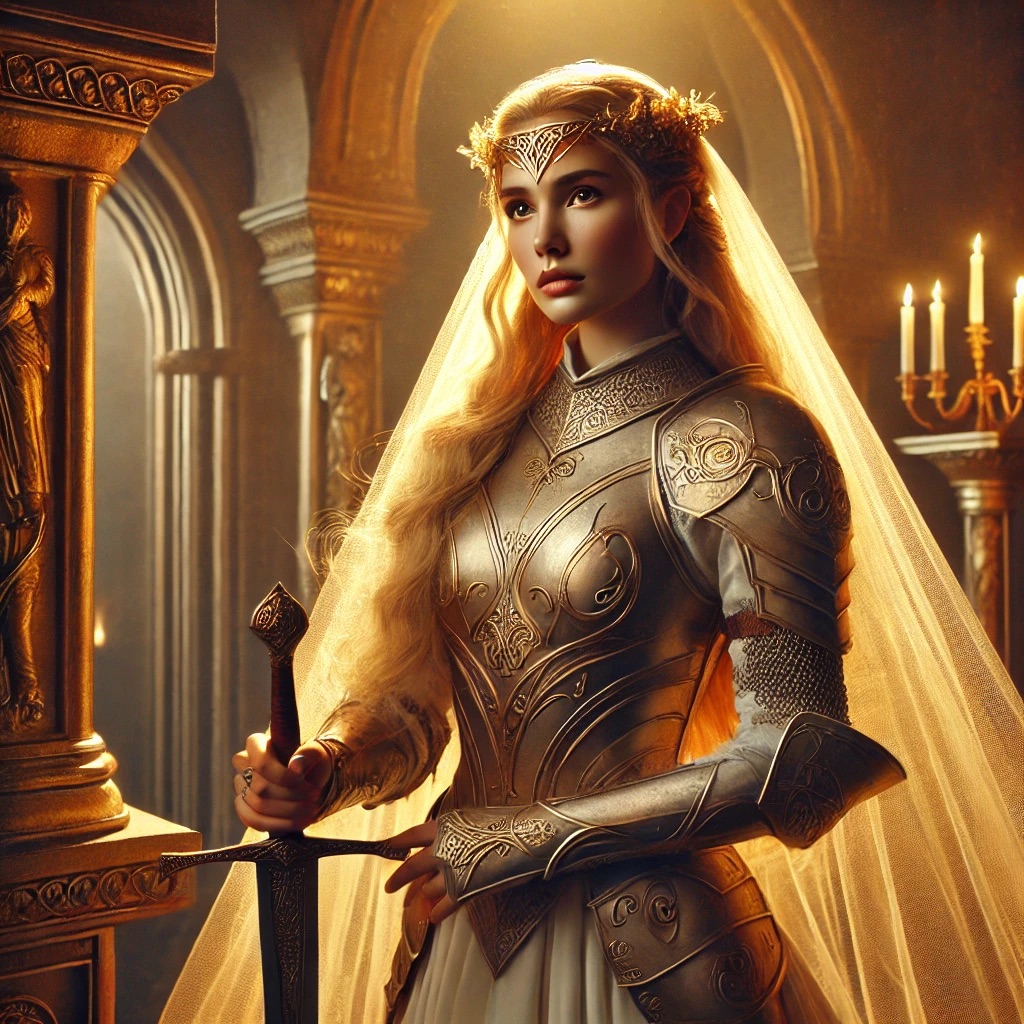
In her frustration, Éowyn disguises herself, takes up the sword, and rides to war. And here is where the parallel deepens—for the Church, too, took up arms. You and I both know she did not do so lightly, nor did she do so for love of war. Yet from the moment Constantine first painted the cross upon his standards, Christ’s Bride began to fight battles not only of the soul but of the sword. The Church took upon herself the mantle of kings and commanders, protecting not only her own but all of Christendom, standing against the long night of barbarism and the encroachments of foreign powers.
Like Éowyn, she was no longer only a bride awaiting her bridegroom—she became a shieldmaiden, not because she wished for war, but because war was thrust upon her.
The Witch-King and the Poison of Battle
And then, of course, comes that moment upon the Pelennor Fields—that moment that is almost too rich with meaning to be accidental, though I suspect you will deny any intention in it. I mean Éowyn’s encounter with the Witch-King of Angmar.
You recall, of course, that Éowyn does not merely fight him—she inhales his very breath, that ghastly, poisonous vapor, the Black Breath of despair. And it is here that the analogy grows most piercing, for what is this corruption, this sickness of the soul, if not the long and bitter consequence of the Church’s wars?
That which she fought against, she also, to some degree, imbibed. The Bride of Christ who had once spread the gospel with words now found herself wielding steel; she crushed enemies, but the dust of the battlefield clung to her.
- The Crusades, the Inquisition, the Wars of Religion—necessary or not, these left their mark.
- The Church, in defending herself, also became entangled in the very political and military forces she once sought to rise above.
- Like Éowyn, she did not emerge from battle unscathed. She gasped for breath, wounded not only by her foes but by the very nature of battle itself.
The Crossroads: Warrior or Healer?
And now, dear Professor, we come to what I think is the most pressing and perilous part of the analogy—the part that still has not been resolved. Éowyn, in the Houses of Healing, faces a choice. She could, if she wished, remain a warrior. She could ride again, take up arms, and keep fighting battle after battle.
But she chooses instead another path—one that leads to love, restoration, and the renewal of life.
Is this not the choice before the Church even now?
For centuries she fought, because fight she must. But now the great earthly battles are no longer hers to wage. She stands at a crossroads:
- Will she remain a shieldmaiden, forever entangled in the political and military struggles of the world?
- Or will she embrace at last her truer role as healer and bride?
It is a question, I think, that the Church has yet to answer with finality. She still wears the dust of battle, still breathes the air of the Witch-King. Even now, she is divided between those who would still wield the sword and those who would lay it down.
The Bride of Christ: Choosing Love Over Perpetual War
Perhaps, like Éowyn, she will one day say,
“I will be a shieldmaiden no longer, nor vie with the great Riders, nor take joy only in songs of slaying.”
Perhaps she will embrace her Faramir—the true heir, not of war, but of wisdom and quiet strength. Or perhaps she will ride once more to battle, unable to put away the warrior’s mantle.
I wonder, dear Professor, which fate you foresee for her?
Yours most sincerely,
Dorothy L. Sayers
 Radically Happy
Leave a comment