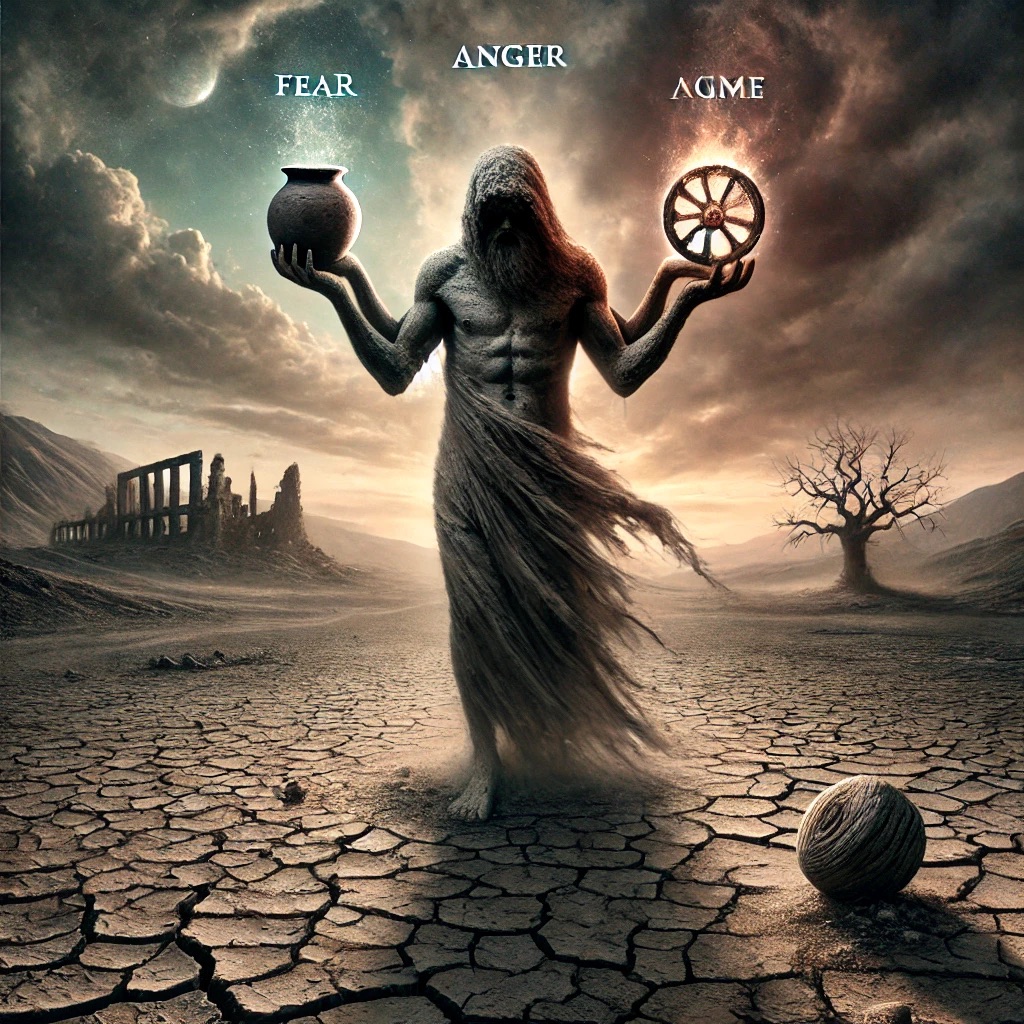
Gifts of Immanuel versus Mark of Cain
- Gold of Father’s wisdom versus clay of fear
- Frankincense of Spirit’s power versus charcoal of anger
- Myrrh of Christ’s love versus wheel of shame
Assume a literal Cain, whose discovery of irrigation led to conflict and the killing of his pastoral brother. The Marks of Cain become the tragic tools necessary to build cities and civilization.
ChatGPT Prompt
Write a story where God gives Cain these three gifts (fear/anger/shame) to protect him after being cast out. They are powerful, but carry the seeds of their own destruction.
Add the epilogue where his descendants the magi break the cycle by giving the opposite gifts to the Christ child.
The Sentence
Cain knelt trembling in the shadow of the Lord, the blood of his brother still staining his hands. The earth beneath him felt both heavy and hollow, as though it recoiled from his very presence.
“Your brother’s blood cries to Me from the ground,” the voice of the Lord thundered. “The earth will no longer yield its strength to you. You shall be a wanderer upon it, cast out from the land of your birth.”
Cain’s voice cracked with despair. “My punishment is greater than I can bear. Anyone who finds me will kill me!“
The Lord’s tone softened, but His words carried both judgment and mercy. “Not so. I will mark you, Cain, that none may harm you. Yet the marks you bear will not be without cost, for they are both your protection and your burden. Through them, you will shape the world, but at a price.“
The Gifts of the Mark
God reached into the earth and the remnants of Cain’s broken altar, drawing forth three forms: the clay of the soil, a shard of blackened charcoal, and a circular wheel. These He handed to Cain, one by one.
1. The Clay of Fear
The Lord held up the damp clay, malleable and fragile.
“This is fear, Cain. It will protect you, for it will drive you to build walls, to seek shelter, and to plan for survival. But beware: fear hardens, and when it does, it becomes a prison. Use it wisely.“
Cain grasped the clay, its coolness chilling his skin. He felt its potential and its weight, knowing that fear would guide his steps but might also tether him to his guilt.
2. The Charcoal of Anger
Next, the Lord gave him a piece of blackened charcoal from the altar fire.
“This is anger, Cain. It will protect you, for it will drive you to act, to defend yourself, and to forge tools of strength. Yet it also destroys. Anger consumes if it is not tempered by love. Master it, or it will master you.“
Cain clutched the charcoal, feeling its heat linger in his palm. The spark of his rage, though subdued, still smoldered within him.
3. The Wheel of Shame
Finally, the Lord placed in Cain’s hands a crude wheel, smooth yet unrelenting in its endless turn.
“This is shame, Cain. It will protect you, for it will keep you from repeating your sin. Yet it is a heavy burden. It will drive you forward, but it will also remind you always of what you have lost. Use it to build, not to destroy.“
Cain accepted the wheel, its weight pressing down on him. He saw both its curse and its promise.
The Journey of Cain
Marked by these gifts, Cain wandered the earth, settling in the land of Nod. He used the clay of fear to shape walls and fortresses, creating the first inklings of cities. The charcoal of anger became the fire in his forge, crafting tools and weapons that allowed his descendants to survive and thrive. The wheel of shame turned endlessly in his mind, driving him to build and innovate, though its weight never left his heart.
Yet the gifts carried seeds of their own destruction. Fear hardened into mistrust, birthing walls that divided people. Anger sparked endless conflicts, each generation wielding Cain’s tools against one another. Shame drove progress, but it also crushed hope, leaving many to toil under its weight.
Cain’s descendants became builders of cities and civilization, yet their legacy bore the mark of the same brokenness that had driven their ancestor to violence.
The Epilogue: The Magi’s Redemption
Centuries later, among Cain’s descendants were wise men who had studied the heavens and the writings of old. These magi bore the wisdom of their forefather, yet they also carried the knowledge of the curse that had shaped their line. When a star appeared in the sky, they discerned its meaning: a King had been born, one who would break the cycle of fear, anger, and shame.
The magi set out on a journey, bringing gifts—not the tools of the Mark of Cain, but their opposites. At the feet of the Christ child, they knelt and presented these offerings.
1. Gold of the Father’s Wisdom
In place of the clay of fear, they brought gold, pure and unyielding.
“This gold is not of fear,” they said, “but of wisdom and trust in the Father, who provides and protects without walls or barriers. We offer this to the King of Kings, who will lead with love and truth.”
2. Frankincense of the Spirit’s Power
In place of the charcoal of anger, they brought frankincense, fragrant and ascending.
“This incense is not of anger,” they said, “but of the Spirit’s power, which heals rather than destroys. We offer this to the Prince of Peace, who will temper the flames of wrath with the breath of life.“
3. Myrrh of Christ’s Love
In place of the wheel of shame, they brought myrrh, a balm of healing and preparation.
“This myrrh is not of shame,” they said, “but of love that redeems and restores. We offer this to the Lamb of God, who will bear our burdens and free us from the weight of sin.“
The Breaking of the Cycle
As the magi departed, the gifts they left behind were more than offerings—they were declarations. In the child they worshipped lay the fulfillment of what Cain had sought in vain. Where fear, anger, and shame had built civilization, trust, peace, and love would now redeem it.
The Christ child, marked not by the burden of sin but by the promise of salvation, would carry humanity beyond the legacy of Cain into the light of grace. And so, the Marks of Cain, once tragic tools of survival, began to fade in the dawn of redemption.
 Radically Happy
Leave a comment