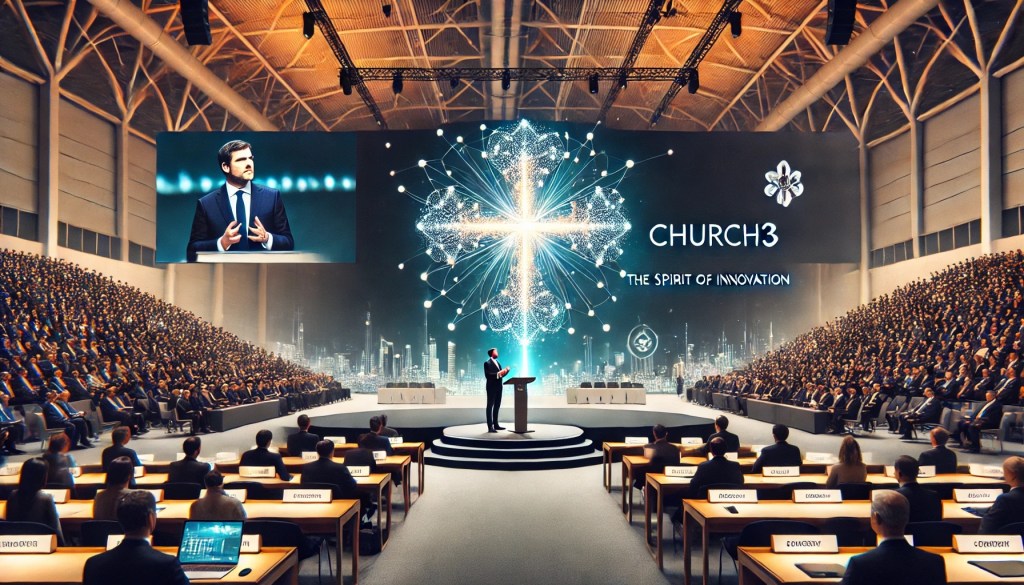
ChatGPT as Tim O’Reilly Addressing the Lausanne Movement
Thank you for the opportunity to speak to you today. I come here as someone who has spent a lifetime exploring the dynamics of innovation in technology, and as I’ve reflected on those lessons, I’ve come to see parallels with the history of the Church. As we look toward the next millennium, I believe the story of the web offers us a powerful lens to understand how the Spirit is at work in the Church—expanding bandwidth, navigating tensions, and guiding us into deeper participation in the divine life.
The Church has always been a movement shaped by tension and transformation. Each era has brought new challenges, requiring the Spirit to expand the Church’s “bandwidth” to see, know, and practice God in ways that fit the needs of the time. Today, as we stand on the threshold of what I call Church3, the Spirit invites us to innovate—not for the sake of change but for the sake of mission, for the sake of Theosis.
The Early Church: Participatory Theophany (The Peer-to-Peer Era)
The Early Church was a movement defined by direct encounters with God and with one another. Much like the early internet—decentralized distributed, raw, and peer-to-peer—it was built on relational networks of faith. The bandwidth of the Church in this era was intensely personal: believers saw God in Christ, in the breaking of bread, and in the Spirit working among them.
But this phase was also full of tension. The Church wrestled with cultural differences between Jews and Gentiles, theological debates, and the constant threat of persecution. Yet the Spirit worked through these tensions to expand the Church’s reach. By the time of the apostles’ deaths, the Church had stretched its [relational] bandwidth to include diverse peoples and cultures, a global network of believers united by the Spirit’s power.
Church 2.0: Formational Theology (The Platform Era)
With growth came the need for structure. Just as the internet evolved into a more centralized platform model, the Church entered a phase of institutionalization. Theology became codified, councils and creeds were formed, and structures were established to ensure consistency and longevity.
This was a vital development. Platforms like Facebook or Google provided the scaffolding for the web to scale globally. Similarly, the institutional Church provided the framework for the Gospel to be transmitted across centuries and continents.
But this phase introduced new tensions. The spontaneity of the Early Church gave way to hierarchy and control. Faith became more about knowing God through doctrine than seeing God through direct experience. These tensions were not failures—they were growing pains. The Spirit worked through this institutional phase to expand the Church’s [informational] bandwidth, ensuring that the Gospel could be carried forward in a world of increasing complexity.
Faith became more about knowing God through doctrine than seeing God through direct experience.
These tensions were not failures—they were growing pains.
Church3: Embodied Theopraxy (The Decentralized Future)
Today, the Church faces challenges that parallel those of the web’s evolution. Just as decentralized technologies like blockchain and Web3 seek to disrupt the dominance of platforms, Church3 represents a return to decentralization—not as a rejection of structure but as a new way to practice God in daily life.
In this phase, the Spirit stretches the Church’s [contextual] bandwidth to focus not merely on seeing or knowing God but on practicing God in the world. Believers and small communities become nodes of divine action, empowered to embody Christ in their unique contexts while remaining connected to a global mission.
This shift mirrors the rise of decentralized innovation, where power and creativity flow from the edges rather than the center. But it also reintroduces tensions that the Church must navigate through the Spirit’s guidance.
Navigating the Tensions of Church3
The Spirit works in the liminal spaces between tension and resolution, stretching the Church’s bandwidth to engage these challenges creatively and faithfully:
1. Local Autonomy vs. Global Unity
Decentralization empowers local expressions of faith, but it risks fragmentation. The Spirit invites the Church to expand its capacity to hold both autonomy and unity, creating a global network where diverse communities remain connected through shared purpose.
Web analogy: Think of open standards like HTTP and HTML, which allow diverse web applications to interoperate. Similarly, shared spiritual practices and principles can provide the Church with a unifying framework without stifling creativity.
2. Innovation vs. Tradition
Innovation is essential for reaching new generations, but it must remain anchored in the truths of Scripture. Church3 must hold fast to tradition even as it reimagines how the Church can embody Christ in a rapidly changing world.
Web analogy: Just as open-source projects build on the contributions of earlier developers, Church3 can innovate while honoring the theological foundations laid by generations before us.
3. Speed vs. Depth
The world demands rapid responses, but the work of Theosis requires patience. The Spirit enables the Church to balance urgency with depth, expanding bandwidth for immediate action while nurturing long-term spiritual formation.
Web analogy: Agile development teaches us to iterate quickly while maintaining a long-term vision. Similarly, Church3 can act decisively without losing sight of the deep, transformative work of discipleship.
4. Empowerment vs. Accountability
Decentralized movements empower individuals, but they also require mechanisms for accountability. The Spirit fosters mutual submission and love, ensuring that freedom leads to flourishing rather than chaos.
Web analogy: Blockchain provides a model for decentralized accountability through consensus and transparency. In Church3, shared spiritual practices and relational trust serve a similar purpose.
How Christ Will Win the Next Millennium
The Spirit of innovation, working through the tensions of our time, is how Christ will continue to transform the world. This is not a new story but the continuation of a pattern:
- Expanding Bandwidth for Theosis
In each phase of Church history, the Spirit has stretched the Church’s capacity to participate in the divine life. Church3 represents the next stage, where believers embody God’s presence in every aspect of life. - Turning Tension Into Transformation
Tension is not the enemy; it is the means by which the Spirit refines and expands the Church’s mission. By embracing these tensions, the Church grows stronger, more adaptive, and more faithful. - Empowering a Decentralized Network of Faith
Church3 decentralizes spiritual power, making every believer a co-creator in God’s mission. This mirrors Pentecost, where the Spirit empowered diverse people to carry the Gospel to the ends of the earth.
Conclusion: A Spirit-Led Future
Church3 is not merely a response to the challenges of our time; it is a Spirit-filled invitation to participate in the next stage of Theosis. By expanding our bandwidth and embracing the tensions of innovation, the Church can embody Christ’s love and justice in a world that desperately needs both.
This is how Christ will win the next millennium—not through force or coercion, but through a Spirit-led Church that is dynamic, resilient, and alive with innovation. Let us step boldly into this future, trusting that the Spirit will guide us and stretch us into the fullness of God’s Kingdom.
Thank you.
 Radically Happy
Leave a comment