Tag: theology
-

The Grasshopper Cure: Molting Into Christ
When Jesus speaks of taking up the cross daily, He is not prescribing religious misery. / He is describing the necessary process of transformation by which the false self dies so that the true self may live. // This death is not primarily about losing things, but about being freed…
-

The Silver Law of Theocracy
The Iron Law tells us how institutions entrench themselves in power. / The Silver Law tells us how they lose their soul.
-

How to Honor the Law: A Diaphoric Interview
I have spent my life teaching the moral vision of the New Testament — but I confess the question still stirs me. / Not just “How do I obey the Law?” / But how do I honor it — as Scripture, as tradition, as divine wisdom — without idolizing it?
-

Diaphoris: Towards a Grand Unified Theology of Generativity
Whereas perichoresis describes the mutual indwelling of the Trinity in harmonious unity, diaphoris highlights the dynamic, recursive, and ecstatic agonism of divine being – a continual pattern of connection and separation that yields unbounded generativity…
-

Rest Before You See: A Theological Clarification on “Seeing vs Doing”
Here, “place of repose” is more than psychological; it is ontological and covenantal—a rest in Being itself, an invitation to abide in the Ground of Being. To propose “seeing” without first entering this repose may risk perpetuating the same depth-anxiety your essay seeks to address.
-

Trinitarian Theosis: The Three Names of Revelations 3:12
Write as St. Gregory Palamas to a novice, using this “[gloss]” on Revelation 3:12 ChatGPT Prompt “I will write on you the name of my God [love], and the name of the city of my God, the New Jerusalem [peace]… And I’ll write my own name [joy] on you.” The…
-

Defending Diaphoric Participation: Towards a Grand Unified Theology
John (raising a brow): You are dangerously close to universalizing a metaphor. // Presenter: True. But I argue it’s more than a metaphor–it’s a **meta-structure**. Diaphoric participation is _how_ theology happens, not just what it says.
-

Defending Diaphoris: A Thesis Committee Across Time
Gregory: Hmm. Ecstatic agony, you say. That’s almost erotic. I rather like it. Reminds me of what I called “divine eros” in my Fifth Theological Oration. Though you walk a dangerous path—difference must be borne without division. The Trinity is not tension, but harmony…
-

Is It Unbiblical for Protestants to Reject Mormonism for Being Unbiblical?
That is, can Protestants—who themselves broke with centuries of tradition in the name of sola scriptura—consistently exclude Mormons simply because they appeal to different sources of authority or interpret Scripture differently?
-

The Epistle of San Francisco (On Burnout)
Brothers and sisters, / You build wonders with your hands and minds– / devices that speak across oceans, / algorithms that learn, / platforms that reach millions. // But I ask you gently, // **Does what you build remember that the Word became flesh?**
-

Final Sacrifice: Why Jesus — and We — Recoil from the Cross (Beyond Existentialism)
The moment in Gethsemane is not terrifying because of the Cross itself — many men have died on crosses, many with more composure. No, the dread of the God-man is something infinitely deeper: He is asked not merely to die, but to let die His understanding of God… [Dedicated to…
-

Relational Space: Navigating Everything Jesus Commanded Us to Do
– Father Son / – Self Other / – Kingdom World // This is how divergence ultimately leads to converge and transformation (and vice versa — if we follow hard enough)…
-

The Spiritual Equivalence Principle: Unforgiveness as Blaspheming the Holy Spirit
Just as Einstein revolutionized our understanding of gravity by showing that acceleration and gravitation are indistinguishable within a closed system, I believe Jesus reveals a spiritual symmetry: unforgiveness and blasphemy against the Holy Spirit, though seemingly distinct, may be functionally equivalent in their impact on the soul.
-

Interpreting “One New Humanity” Through a Diaphoric Lens
Applying the concept of diaphoris, as introduced in Diaphoris: The Ecstatic Agony of Divine Glory, provides a nuanced framework to understand the themes presented in One New Humanity. Diaphoris emphasizes the sacred dynamic by which difference is borne, crossed, and ultimately reconciled, generating deeper communion.
-

Diaphoris: The Ecstatic Agony of Divine Glory
But this “oneness” isn’t static. It’s not a melting into indistinction. It’s a communion of distinction, a unity born of love through difference. The key lies not merely in perichoresis—the classic doctrine of the mutual indwelling of the Trinity—but in something more dynamic, more painful, more creative…
-

Did Christ Die to Cause or Transmit Forgiveness?
He is not a nicer version of God, nor a shield protecting you from divine anger. When you look upon Christ crucified, you are seeing the heart of the Father made visible…
-

Christ the Only True Heresy: Rejecting Unbiblical Separation
In the style of Revelations 2-3, have Christ appear to a worshipper to restore the Biblical meaning of heresy by rejecting the human invention of orthodoxy [see Appendix] / ChatGPT Prompt (condensed)
-
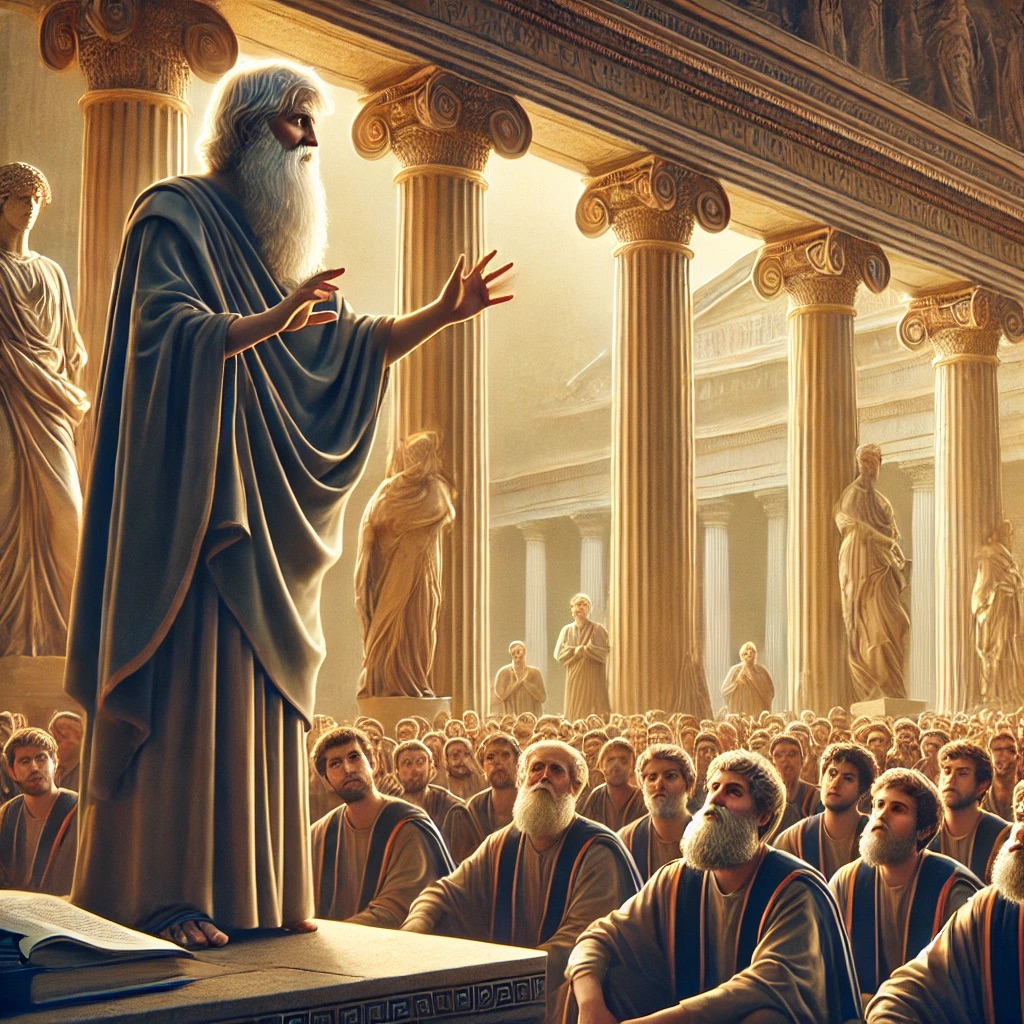
Master of Grace, Doctor of the Cross (ChatGPT as St. Gregory the Theologian)
“Today we stand on the threshold of a world in need of healers, not mere thinkers; physicians for the soul, not just rhetoricians for the mind. Your years in Athens, the city of wisdom, have sharpened your intellect, but now you must graduate into the school of grace, where the…
-

Church3 and the Spirit of Innovation: How Christ Will Win the Next Millennium
The Church has always been a movement shaped by tension and transformation. Each era has brought new challenges, requiring the Spirit to expand the Church’s “bandwidth” to see, know, and practice God in ways that fit the needs of the time. Today, as we stand on the threshold of what…

 Radically Happy